
Form 6 Row Explained: How Bihar SIR Led To Supreme Court Questions Over Voter Enrolment Form

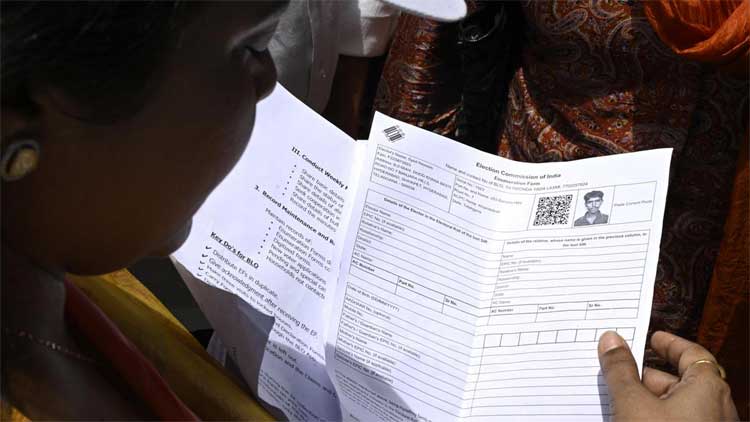
The Supreme Court on Monday clarified that it had not approved any modified version of Form 6, the statutory application used to enrol new voters, and sought records from the Election Commission of India (ECI) to determine who authorised changes to the online version of the form.
The observation has brought renewed attention to a controversy that began with the Special Intensive Revision (SIR) of electoral rolls in Bihar in June 2025 and intensified after an SIR-related declaration appeared alongside the online Form 6 on the ECINET portal.
The ECI has maintained that the statutory Form 6 was never amended and that the disputed provision was a separate declaration applicable to the SIR exercise. The Commission has also said its SIR decisions were unanimously approved. However, an Indian Express report said Election Commissioners Sukhbir Singh Sandhu and Vivek Joshi had formally raised objections to the change.
Here is a timeline of how the Form 6 controversy unfolded:
June 24, 2025: ECI Orders SIR In Bihar
The Election Commission ordered a Special Intensive Revision of Bihar’s electoral rolls, the first such exercise in the state since 2003.
The ECI said the exercise was aimed at ensuring that all eligible citizens were enrolled while excluding ineligible persons. It cited factors including rapid urbanisation, migration, unreported deaths and the alleged presence of foreign illegal immigrants.
Under the order, a person seeking registration as a new elector was required to submit Form 6 along with an additional declaration linking themselves or their parents to the 2002 electoral rolls.
June-July 2025: Bihar SIR Begins
The Bihar SIR began on June 25 with house-to-house enumeration.
While statutory Form 6 remained the prescribed application for inclusion in the electoral rolls, the online SIR process required applicants to submit the additional declaration.
October 27, 2025: SIR Phase 2 Announced
The ECI ordered the next phase of SIR in 12 states and Union territories, with January 1, 2026, as the qualifying date.
The enumeration process began in November, extending the Bihar model to a much wider geographical area.
May 14, 2026: Third Phase Of SIR Announced
The ECI announced the third phase of SIR across 16 states and three Union territories.
The states included Andhra Pradesh, Arunachal Pradesh, Haryana, Jharkhand, Karnataka, Maharashtra, Manipur, Meghalaya, Mizoram, Nagaland, Odisha, Punjab, Sikkim, Tripura, Telangana and Uttarakhand. The exercise also covered Delhi, Chandigarh and Dadra and Nagar Haveli and Daman and Diu.
The Commission said the exercise would eventually cover the entire country, except Himachal Pradesh, Jammu and Kashmir and Ladakh, whose schedules would be announced separately.
May 27, 2026: Supreme Court Upholds Bihar SIR
The Supreme Court upheld the ECI’s authority to conduct the Bihar SIR.
The judgment noted that under the June 24, 2025 order, a person applying for registration as a new voter was required to submit Form 6 along with Annexure D.
The court recognised the additional declaration as part of the SIR framework. It observed that while Form 6, prescribed under the Registration of Electors Rules, 1960, provides the documentary framework for ordinary voter registration, it was designed for the regular revision process and could not necessarily be applied literally to an exercise such as SIR.
The court said the Commission retained “a degree of residual authority” to formulate an appropriate documentation framework suited to the requirements of a Special Intensive Revision.
However, the judgment did not approve any modification of the statutory Form 6 itself. That distinction has now become central to the controversy.
September 23, 2026: Report Flags ECs’ Objections
The Indian Express reported that Election Commissioners Sukhbir Singh Sandhu and Vivek Joshi had formally objected at least 14 times over 10 months to decisions and actions they alleged were taken without their knowledge.
One of the issues reportedly concerned Form 6.
September 24, 2026: ECI Calls Decisions Unanimous
The ECI responded to the report by saying that differences of views and observations were a normal part of institutional deliberations.
The Commission maintained that all decisions taken during the previous year, including those related to electoral-roll revisions and SIR, were the result of “unanimous decisions of the full Commission.”
However, the ECI did not explain in that response who authorised the disputed Form 6 change or why the additional declaration appeared online despite the reported objections.
September 26, 2026: ECI Reiterates Its Legal Position
The Commission issued a detailed press note after a meeting and said the “declaration attached to Form 6 for SIR has been upheld by the Hon’ble Supreme Court.”
It clarified that outside an SIR period, the forms prescribed under the Registration of Electors Rules, 1960, would continue to apply.
September 30, 2026: Declaration Removed In States Where SIR Ended
The ECI removed the SIR declaration from the online Form 6 available on ECINET in states where the SIR exercise had concluded.
The declaration remained available in states where the SIR was still underway.
The move followed the Commission’s September 26 clarification that statutory forms under the Registration of Electors Rules would apply outside the SIR period.
October 5, 2026: Supreme Court Says It Did Not Approve Modified Form 6
The issue returned to the Supreme Court on Monday during a hearing concerning the functioning of Chief Election Commissioner Gyanesh Kumar.
Senior Advocate Menaka Guruswamy referred to the Form 6 issue and alleged that an altered version had been used in Delhi.
Chief Justice Surya Kant clarified that the court had not approved a modified Form 6.
“Let’s be very clear. Any modified Form 6 has not been approved by us,” the CJI said.
The Chief Justice further indicated that after receiving the ECI’s report, the court wanted to establish “who has modified what.”
The court’s demand for records is now expected to shed light on whether the disputed provision was merely an SIR-specific declaration, as the ECI maintains, or whether the statutory Form 6 itself was modified and, if so, who authorised the change.
Comments are closed, but trackbacks and pingbacks are open.