
‘We’re Not Giving Up’: Island Nations Warn Of Climate Crisis As Seas Rise

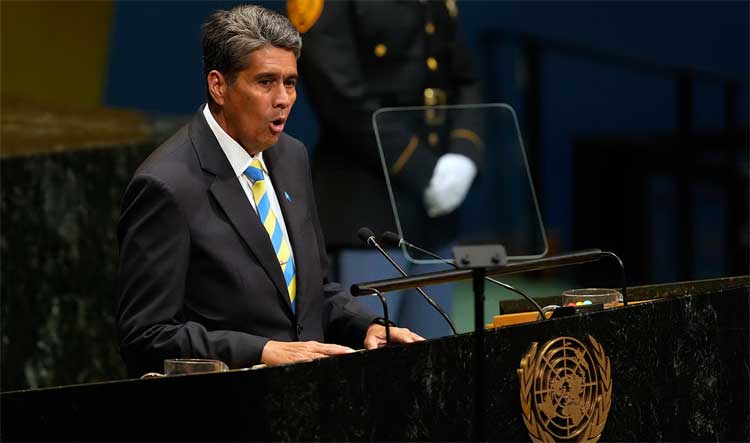
Small island nations are using the United Nations General Assembly to draw attention to the growing threat posed by climate change, warning that rising seas are already eroding land, damaging communities and putting their cultural identities at risk.
Palau President Surangel Samuel Whipps Jr. recently returned to Helen Island with his children, about four decades after his previous visit, only to find that nearly two-thirds of the island had disappeared. Rising seas had also swallowed generational burial grounds, which Whipps said represented a devastating loss for his people.
“For us, it’s devastating,” Whipps told The Associated Press. “It doesn’t mean we should give up.”
Small Islands Face A Disproportionate Climate Threat
Although island nations contribute relatively little to global greenhouse gas emissions, they are among the places facing some of the most direct consequences of a warming planet.
At the 2015 Paris climate talks, small island states pushed for the global temperature goal to be tightened to 1.5 degrees Celsius above pre-industrial levels, arguing that limiting warming was critical to their survival. Scientists and the United Nations now expect the world to exceed that threshold on a longer-term basis in the coming years unless emissions are sharply reduced.
Anna Rasmussen, chief negotiator for the Alliance of Small Island States, warned that every additional fraction of warming increases the risk of irreversible sea-level rise.
“We absolutely cannot surrender our pursuits of 1.5,” Rasmussen said.
Joyelle Clarke, environment minister of Saint Kitts and Nevis, described the consequences in stark terms, saying that exceeding 1.5 degrees of warming could mean “death” for vulnerable island communities.
Rising Seas Threaten Homes, Schools And Freshwater
Marshall Islands President Hilda Heine told the UN General Assembly that island nations were facing an injustice because they had contributed comparatively little to the climate crisis while bearing its consequences.
She cited schools damaged by rising seas, saltwater contamination of freshwater supplies and disease outbreaks associated with environmental changes. Heine called for the issue to be addressed and said affected communities deserved restitution.
For Caribbean and Pacific nations, the effects are increasingly visible in places that are often portrayed as tourist paradises.
Clarke said beaches that attract visitors are disappearing, while young people in island communities are increasingly questioning whether they have a secure future.
“We’re seeing a generation that’s losing hope,” she said.
Island Nations Push For Recognition At UN
Island nations have also been seeking international guarantees that rising sea levels will not erase their sovereignty or maritime rights.
The United Nations earlier this week adopted a resolution supporting the continued sovereignty and marine rights of small island states despite the effects of rising seas. Their leaders have stressed that climate-driven changes to territory should not determine whether their nations continue to exist as political and cultural communities.
Tuvalu Prime Minister Feleti Teo said his country has only about 26 square kilometres of land but is responsible for an ocean area of roughly 750,000 square kilometres.
“Tuvalu’s nationhood is not negotiable,” Teo said, describing climate change as the “single greatest existential threat” to his country.
Adão Soares Barbosa, Timor-Leste’s special envoy on climate affairs and chair of the Least Developed Countries Group on Climate Change, similarly urged larger nations to move beyond promises.
“The survival of our nations cannot be negotiated,” he said.
‘We’re Not Giving Up’
Marshall Islands Foreign Minister Kalani Kaneko said his country’s people were determined to preserve their communities, language and identity despite the growing climate threat.
“We’re not giving up,” Kaneko said.
For Palau’s Whipps, the crisis is also becoming a question about future generations. He said some young people were reluctant to have children because they feared bringing them into a world facing worsening environmental problems.
The concerns expressed by island leaders at the UNGA underline a broader message: for countries already experiencing land loss, saltwater intrusion and disappearing beaches, climate change is not a distant threat but an immediate challenge to their homes, economies and cultural identities.
Comments are closed.