Stone-pelting by CJP protesters continued after Parliament march violence, say officials

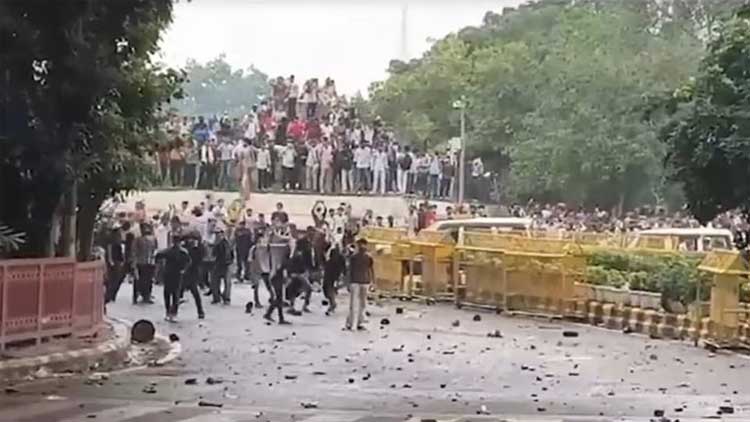

Stone-pelting and clashes during protests over the alleged NEET-UG paper leak continued for nearly six days in central Delhi, but police responded with restraint to prevent the situation from escalating, according to security officials familiar with the developments.
Officials said that while the demonstrations initially drew genuine students, a section of political activists allegedly infiltrated the gathering at Jantar Mantar and triggered violence during the agitation.
The most serious confrontation occurred on July 20, when protesters marched towards Parliament while the House was in session. Police resorted to a baton charge and fired tear gas after repeated warnings, alleging that demonstrators pelted stones, damaged barricades and attempted to breach security cordons in the high-security zone.
According to officials, sporadic stone-pelting continued until July 25, when the protest ended after the government accepted key demands, including the resignation of then Education Minister Dharmendra Pradhan. They maintained that police avoided further escalation despite repeated incidents.
Documents reviewed by officials show that the unrest was spread across several locations within a roughly two-kilometre radius of Parliament, rather than being confined to a single site.
The reported flashpoints included Gol Dak Khana, the Tolstoy-Janpath crossing, the Rafi Marg barricade near Rail Bhawan, Jantar Mantar, Outer Circle near the LIC Building in Connaught Place, stretches along the Tolstoy-Sansad Marg corridor, Sansad Marg near the SBI Building, Raisina Road near the Press Club of India, and the Regal Building near the Sansad Marg-Tolstoy intersection.
Officials said stone-pelting was reported at all of these locations, with the Rafi Marg barricade near Rail Bhawan being the closest to Parliament.
According to the document, the violence resulted in significant damage to government property. Authorities reported that 110 barricades and 171 ropes were damaged or went missing. Operational equipment, including a wireless set, a body-worn camera, 10 handheld metal detectors, two public address systems, 15 loudhailers, 10 fire extinguishers, four wire cutters and an X-ray baggage scanner, was also lost or damaged.
Protective gear such as 355 helmets, 285 body protectors, 54 shields, 10 torches, 24 first-aid boxes and 12 blankets was reported missing or damaged.
The document further stated that 29 official vehicles—including police cars, buses, motorcycles and tempos—as well as a water tanker, a DTC bus and one public vehicle, were affected during the unrest.
Authorities also recorded injuries to 244 police personnel and 209 civilians, all documented as Medico-Legal Cases (MLCs).
Security officials reiterated that the use of force during the Parliament march followed repeated warnings, barricade breaches, damage to public property and continued confrontations with police personnel and members of the media.
According to an internal Delhi Police report previously submitted to the government, facial recognition technology identified more than 100 individuals facing murder charges, along with hundreds of others accused in robbery, sexual offence, Arms Act and narcotics-related cases, during the violence surrounding the protests.
Exceptionally skilled Journalist possesses dogged determination to find the story and deliver it to the public. Have authored award-winning exposes and believe in protecting the confidentiality of anonymous sources even in the face of tremendous pressure. Reported on a wide variety of news topics for print and digital editions, Provided compelling coverage of both anticipated and spontaneous news for print and online media.
Comments are closed.