
India’s AI Infrastructure Boom Creates Winners as 28 Firms Add $47 Billion in Value

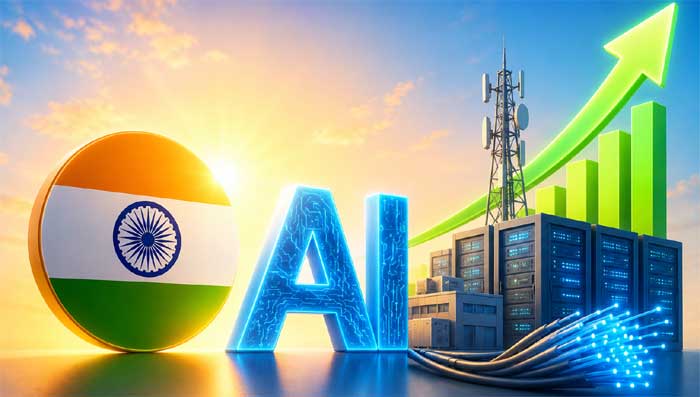
India’s industrial sector is emerging as an unlikely winner in the global artificial intelligence boom, as investors pour money into companies supplying critical infrastructure for data centers powering AI applications worldwide.
According to a Bloomberg report, a growing group of Indian firms involved in manufacturing optical fiber, transformers, cables, switchgear, cooling systems and power equipment have seen their shares soar amid rising global spending on AI infrastructure.
Among the biggest beneficiaries is Sterlite Technologies Ltd., the Vedanta Group-owned optical fiber manufacturer, whose shares have surged more than 530 per cent in 2026. The rally accelerated after the company secured a $1.1 billion multi-year contract from a US-based hyperscaler in May. Rival HFCL Ltd. has also ridden the wave, with its stock gaining 191 per cent this year.
AI Infrastructure Stocks Power Ahead
The rally extends beyond telecom infrastructure providers. MTAR Technologies Ltd., which manufactures precision cooling and power-management components, has more than tripled in value in 2026.
Bloomberg tracked 28 Indian companies linked to the data-center supply chain, including manufacturers of transformers, cables, switchgear and cooling equipment. Together, these firms have added roughly $47 billion in market capitalization this year, with their combined value rising nearly 50 per cent.
The trend has become so prominent that investors in Mumbai have coined a term for it: the “AI capex trade.”
R. Sivakumar, Chief Investment Officer at Axis Mutual Fund, told Bloomberg that while India may not be at the forefront of AI software development, it stands to benefit significantly from the enormous investment cycle surrounding AI infrastructure.
Rather than focusing solely on AI applications, investors are increasingly targeting companies that build and support data centers, he said.
Global Tech Giants Fuel India’s AI Buildout
Much of the optimism stems from massive investment commitments by global technology companies.
Amazon plans to invest $12.7 billion in cloud infrastructure in India by 2030. Meanwhile, Alphabet is reportedly investing around $15 billion in an AI infrastructure hub in Visakhapatnam.
A joint venture involving Reliance Industries signed an $11 billion agreement in 2025 to develop local data centers, while AdaniConnex has partnered with Google and Uber Technologies on data-center projects.
Analysts at Nomura describe equipment suppliers serving the sector as the “picks and shovels” of the AI boom, arguing that they offer one of the clearest ways to benefit from the surge in spending.
Demand has become so intense that delivery timelines for certain components now stretch between two and four years, creating a strong seller’s market for manufacturers. Many orders being secured today are expected to generate revenue between 2027 and 2029.
Industrial Firms Gain From Global AI Race
Although India lacks the large AI software companies and semiconductor manufacturers that have driven stock market rallies elsewhere, the country’s industrial sector is finding its own way to participate in the trend.
Companies such as Hitachi Energy India Ltd., ABB India Ltd. and Cummins India Ltd. are among those benefiting from the increasing need to build, power and cool data centers worldwide.
Brokerage Angel One said investors are increasingly viewing AI as a long-term infrastructure investment cycle rather than merely a software opportunity. That shift in perception has helped fuel the sharp rise in shares of companies such as Sterlite Technologies and MTAR Technologies.
The brokerage estimates that global investment in hyperscale data centers could exceed $1.2 trillion between 2025 and 2027.
Valuation Concerns Begin to Emerge
Despite the enthusiasm, analysts caution that soaring valuations present growing risks.
Angel One noted that the market is rewarding companies already generating AI-related earnings rather than those merely promoting future AI ambitions. However, after such steep gains, investors may have little tolerance for earnings disappointments.
Sterlite Technologies, for instance, is trading at roughly 70 times expected earnings over the next 12 months, compared with around 19 times for the broader NSE 500 index.
Even so, many analysts remain optimistic about the long-term outlook.
Nomura has described data-center spending as the largest industrial investment cycle currently underway globally, arguing that it exceeds the scale of previous infrastructure booms such as the global 4G rollout, the post-2008 LNG expansion and the shale energy boom of the early 2010s.
For investors, the message is increasingly clear: while India may not yet boast global AI software champions, a growing number of its industrial and infrastructure companies are quietly reaping substantial rewards from the worldwide race to build the next generation of AI data centers.
Comments are closed.