
Sabarimala Temple case returns to Supreme Court of India as nine-judge Bench begins hearing today

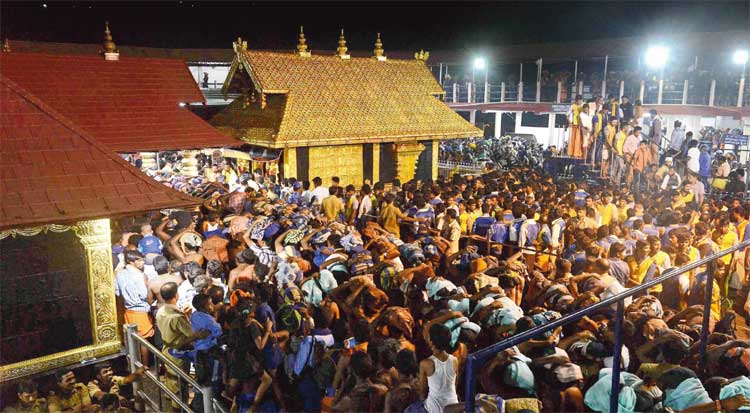
In a case that could reshape the balance between faith and fundamental rights, the Supreme Court of India will begin hearing the Sabarimala reference today before a nine-judge Constitution Bench led by Chief Justice of India Surya Kant.
The Bench — comprising Justices BV Nagarathna, MM Sundresh, Ahsanuddin Amanullah, Aravind Kumar, Augustine George Masih, Prasanna B Varale, R Mahadevan and Joymalya Bagchi — will examine key constitutional questions that extend far beyond the Sabarimala Temple dispute.
At the core of the hearing is the scope of religious freedom under Article 25 of the Indian Constitution and its interplay with rights such as equality and dignity. The court will also consider how far judicial intervention can go in matters of faith and what qualifies as an “essential religious practice”.
Seven broad questions framed earlier include whether denominational rights are subject to other fundamental rights, the meaning of “constitutional morality”, and whether those outside a faith can challenge its practices through public interest litigation.
Beyond Sabarimala
Although the lead case concerns the entry of women into Sabarimala, the ruling is expected to have implications across religions. Issues likely to be influenced include the entry of Parsi women into fire temples after interfaith marriage, excommunication practices among Dawoodi Bohras, and debates around practices such as polygamy and nikah halala.
Bodies like the All India Muslim Personal Law Board and some Jain groups have already submitted written arguments.
Background of the dispute
In September 2018, a five-judge Bench of the Supreme Court, by a 4:1 majority, allowed entry of women of all ages into Sabarimala, holding that devotion cannot be subjected to gender discrimination. The verdict, delivered by then Chief Justice Dipak Misra along with Justices RF Nariman, AM Khanwilkar and DY Chandrachud, struck down Rule 3(b) of the 1965 Kerala rules. Justice Indu Malhotra dissented.
Following multiple review petitions, a five-judge Bench led by then Chief Justice Ranjan Gogoi in November 2019 referred broader constitutional questions to a larger Bench, noting similar issues arise in other religious contexts.
Hearing schedule and participation
The court has set a detailed schedule for arguments over the coming weeks. Parties backing the review petitions — arguing against judicial interference in religious practices — will be heard from April 7 to April 9.
Opposing parties, including original petitioners and women’s rights groups, will present arguments from April 14 to April 16, followed by rejoinders on April 21. Submissions from amicus curiae senior advocate K Parameswar are slated for April 22.
So far, 81 parties have filed written submissions.
Centre, Kerala back review petitions
Ahead of the hearing, both the Centre and the Kerala government have supported the review petitions. The Centre, in its affidavit, argued that restricting entry of women aged 10 to 50 is tied to the nature of the deity, Lord Ayyappa, revered as a “Naishtika Brahmachari”.
It maintained that the practice is not based on notions of impurity or inferiority and does not violate equality, warning that allowing entry would alter the nature of worship and affect devotees’ rights.
The Kerala government has also said customary temple practices should not be overridden by courts.
What lies ahead
The nine-judge Bench is expected to first settle the broader constitutional questions. Individual disputes, including the Sabarimala case, may later be taken up by smaller Benches once the legal framework is clarified.
The hearings, spread over multiple days this month, are likely to have far-reaching implications for how courts interpret religion, rights and state intervention in India.
Comments are closed.