
Climate Change May Trigger More Frequent Dust Storms, Occurring Earlier in the Year: Expert

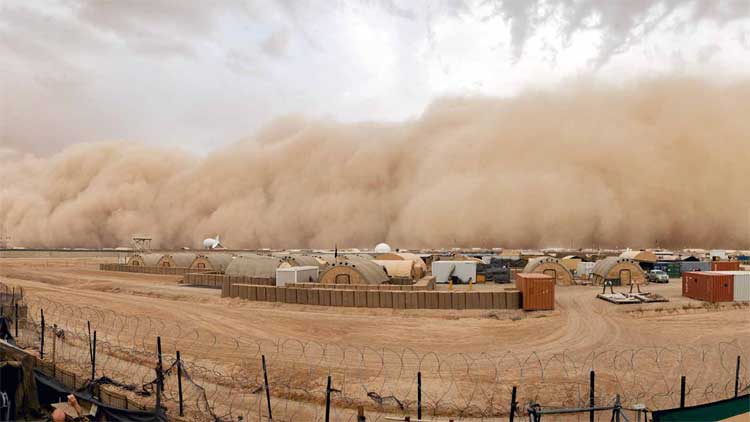
A climate researcher from Hebrew University of Jerusalem has cautioned that dust storms like the one that blanketed Israel over the weekend could become increasingly common and occur earlier in the year due to climate change.
Assaf Hochman, a specialist in climate and extreme weather at the university’s Earth Sciences Institute, explained that Saturday’s severe haze — which pushed Tel Aviv and Jerusalem to the top of global air pollution rankings — was triggered by a storm system near Libya. The system lifted vast amounts of sand and dust from North Africa and Egypt, transporting the particles more than 2,000 kilometers to Israel in a phenomenon known as a sharav cyclone.
Sharav cyclones are low-pressure systems that develop over North Africa and move eastward along the Mediterranean. Unlike winter storms that bring rain, these systems carry hot, dry, and dust-laden desert air.
Hochman noted that such storms are a recurring feature of Israel’s transitional seasons, typically appearing in spring or autumn. “Dust storms usually occur between March and May, or again in September and October,” he said. “This year’s event arrived earlier than expected.”
Under the right atmospheric conditions, he explained, dust particles can travel vast distances and reach high altitudes. Strong winds can lift sand thousands of meters above the ground, allowing it to spread across regions. Similar processes, he added, regularly carry Saharan dust into Europe and even across the Atlantic Ocean to the United States.
While describing the recent storm as intense, Hochman emphasized that it was not without precedent. He referenced a major sandstorm in 2015 that dramatically altered Israel’s skies, which authorities at the time labeled the most severe in the country’s history.
Looking ahead, Hochman said ongoing research suggests that rising carbon dioxide levels — largely driven by fossil fuel combustion — are likely to reshape seasonal patterns. Winters are expected to shorten, while summers may lengthen.
“Spring conditions are projected to arrive earlier, and events like dust storms could become more frequent,” he explained. “The Mediterranean region is becoming drier, leaving more exposed soil and dust. At the same time, land areas are warming faster than the sea, increasing the temperature contrasts that fuel sharav cyclones.”
He warned that more frequent and earlier dust storms could have wide-ranging consequences, particularly for agriculture and public health, as well as for daily life across the region.
Comments are closed.