
Virat Kohli, Rohit Sharma See Role Reversal Under Shubman Gill: Hitman Slows Down as India’s Chase Master Shifts Gears

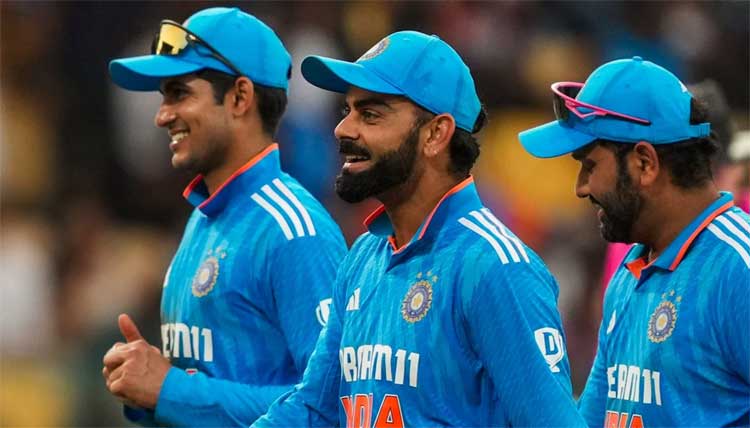
Rohit Sharma’s ODI batting has long been driven by a single instinct: seize control early. For years, that intent was not just evident in his shot selection but reflected clearly in his scoring rate. During his stint as India’s ODI captain, Rohit operated at a strike rate of 111.97 — a figure that aligned perfectly with India’s front-loaded, powerplay-dominant template.
Since the ODI captaincy changed hands, however, Rohit’s numbers reveal something more nuanced than a mere dip in form. What has unfolded is a shift in role and rhythm — one that becomes especially clear when his post-handover tempo is placed alongside Virat Kohli’s over the same period.
The numbers that frame the shift
During Rohit Sharma’s ODI captaincy
-
Rohit Sharma strike rate: 111.97
-
Virat Kohli strike rate: 94.67
After the captaincy handover
(Australia ODIs 2025, South Africa ODIs 2025, New Zealand 1st ODI 2026)
-
Rohit Sharma: 374 runs off 397 balls — SR 94.21
-
Virat Kohli: 469 runs off 442 balls — SR 106.11
For Rohit, that is a drop of nearly 18 runs per 100 balls. For Kohli, it represents a rise of more than 11 runs per 100 balls relative to the Rohit-captaincy baseline. In ODI cricket, these are substantial shifts — not statistical noise, but signals of altered innings distribution.
Rohit’s post-handover innings: aggression by situation, not default
Rohit’s reduced strike rate is not the product of uniform slowdown. Instead, it reflects a pattern of context-driven innings where control has often taken precedence over early dominance.
The clearest example is his 73 off 97 in Adelaide — a classic stabilising ODI innings that prioritised time at the crease over tempo. That knock alone drags down the aggregate, but more importantly, it illustrates the broader shift: aggression is no longer the default setting.
Even his Sydney hundred — 121* off 125 — while authoritative and match-defining, was built on sustained control rather than the explosive powerplay assaults that characterised his captaincy phase. The South Africa series adds further texture. Rohit still produced quick bursts — 57 off 51, 14 off 8, 75 off 73 — but the aggression appeared in phases rather than as a standing opening mandate.
This is how strike rates fall without technical decline: responsibility tilts toward risk absorption, batting longer, and responding to match state instead of forcing a single tempo.
Kohli’s post-handover sample: control with sharper acceleration
Kohli’s post-handover numbers are arguably more revealing. The sample includes early failures in Australia — innings that would normally depress a small-sample strike rate. Yet Kohli still finishes at 106.11, which is only possible if the substantive contributions are played at genuinely higher pace.
South Africa was pivotal. His 135 off 120 was not vintage “bat-deep-at-90” Kohli; it was a middle-overs innings played at sustained aggression. The follow-up 102 off 93 reinforced that approach. Most telling was 65 off 45* — a finisher’s tempo delivered by a batter historically defined by chase control.
The New Zealand opener continued the trend: 93 off 91, again comfortably above a run-a-ball across a long innings.
Placed against his 94.67 strike rate during Rohit’s captaincy, the rise to 106.11 suggests not a change in temperament, but an evolution in method — Kohli scoring faster earlier while retaining his low-risk core.
What this says about India’s ODI innings structure
The pattern points to a structural redistribution rather than individual decline or resurgence. Under Rohit’s captaincy, India’s ODI blueprint was heavily front-loaded: overwhelm the opposition early, force defensive fields, and control the game from the outset.
Post-handover, the evidence suggests recalibration. Rohit’s innings have leaned toward insurance value — stabilising, absorbing pressure, and shaping chases even at the cost of strike rate. Kohli, in turn, has increasingly become the tempo carrier through the middle overs, with a sharper finishing edge than his earlier numbers implied.
In short, the data supports the thesis cleanly. Rohit Sharma’s scoring rate has slowed materially since stepping away from the ODI captaincy, while Virat Kohli’s has risen relative to the same baseline — most clearly across South Africa and into the New Zealand series.
Comments are closed.