
At UN Climate Talks in Brazil, an Empty Chair Marks the Absence of the United States

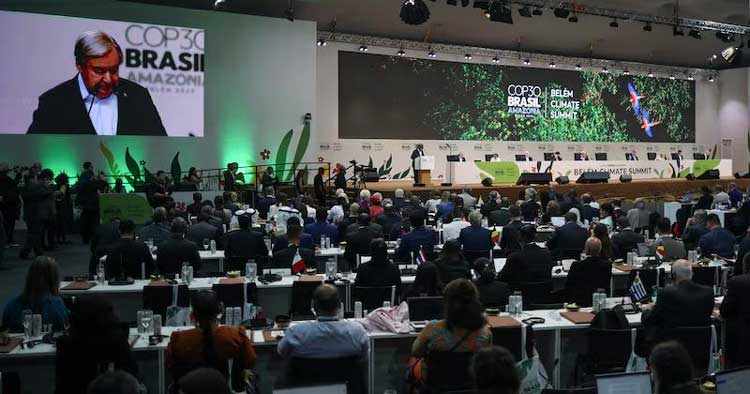
A string of recent weather catastrophes set a somber tone Monday at the opening of the UN climate conference (COP30) in Belém, Brazil — from Hurricane Melissa in Jamaica to a deadly tornado in Brazil and droughts and fires across Africa. Against this backdrop, climate activists placed an empty chair at the venue — a pointed symbol of the United States’ absence from the talks.
World leaders used the moment to highlight the urgent need for collective global action against climate change, which is intensifying extreme weather worldwide. Yet, that collective effort now proceeds without the US, the world’s second-largest carbon polluter, and one of only four nations missing from the summit — alongside San Marino, Afghanistan, and Myanmar.
Representatives from 195 countries gathered in Belém, a historic city on the edge of the Amazon, where negotiators were reminded that only through unity could they cut emissions from coal, oil, and gas that fuel global warming.
“The empty chair isn’t just about America’s absence — it’s a call for others to step in and step up,” said Danni Taaffe of Climate Action Network International.
UN Climate Chief Simon Stiell echoed that sentiment, urging delegates to stay focused:
“Humanity is still in this fight. We face tough opponents, no doubt — but we also have heavyweights on our side, like the sheer market power of cheaper renewables.”
Lula’s Plea for Climate Justice
Host nation President Luiz Inácio Lula da Silva reminded the world that the climate crisis deepens inequality, calling it “an increase of injustice that determines who lives and who dies.”
This year’s COP is being framed as an “implementation conference” rather than one expected to deliver a sweeping new climate accord. Nations were tasked with presenting updated climate action plans, or NDCs (Nationally Determined Contributions).
A UN report released Monday showed that current national pledges could cut projected 2035 greenhouse gas emissions by 12% below 2019 levels — a modest improvement over last month’s 10% reduction estimate.
A Divided Global Front
Calls for cooperation echoed throughout the opening day, with André Corrêa do Lago, Brazil’s chief negotiator and COP30 president, invoking the Indigenous term mutirão — meaning “coming together to get the job done.”
Yet, that unity is challenged by the absence of the United States, which withdrew from the Paris Agreement for the second time after President Donald Trump returned to office. Trump’s administration has since expanded fossil fuel projects, cut renewable energy support, and declined to send any high-level US delegation to Belém.
The Biden administration’s 2024 pledge to cut emissions — a key component of the UN’s current projections — remains in doubt under Trump’s renewed leadership.
“The US withdrawal has really shifted the gravity of these talks,” said Ilana Seid, Palau’s ambassador and chair of the Alliance of Small Island States.
Former US climate envoy Todd Stern criticized Trump’s stance, saying:
“It’s probably for the best they didn’t send anyone — they wouldn’t have been constructive participants.”
‘A Tragedy of the Present’
Despite the setback, former American negotiators and state-level leaders attending the conference argued that US cities, states, and businesses will continue to push climate action independently.
Both Lula and Stiell reaffirmed that while the Paris Agreement remains a working framework, global progress must accelerate dramatically.
“Climate change is not a threat of the future,” Lula warned. “It is already a tragedy of the present.”
Comments are closed.