
Trump, Xi to Meet in South Korea Amid Hopes of Easing US-China Trade Tensions

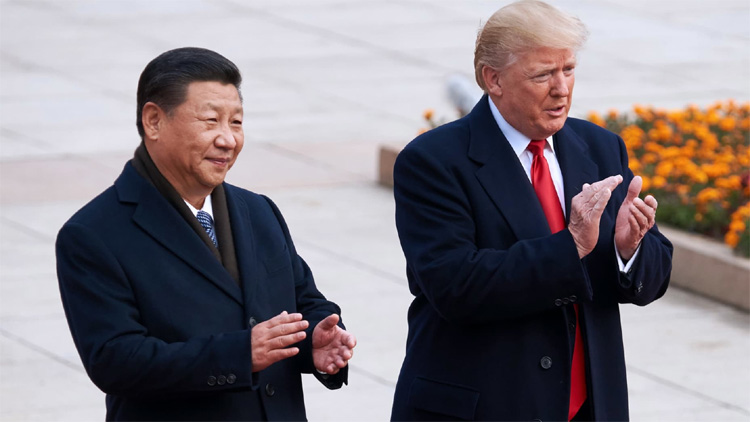
President Donald Trump is set to meet Chinese leader Xi Jinping on Thursday, in a closely watched encounter between the heads of the world’s two largest economies. The talks, taking place in Busan, South Korea, come after months of escalating trade friction and are seen as a chance to stabilize relations before they spiral further.
Trump’s renewed use of tariffs since returning to the White House for a second term, coupled with Beijing’s curbs on exports of rare earth elements, has heightened the stakes. Both sides now appear eager to prevent a full-blown trade confrontation that could unsettle global markets and damage their own economies.
In recent days, U.S. officials have indicated that Trump is unlikely to follow through on his threat to impose an additional 100% import tax on Chinese goods. Beijing, meanwhile, has hinted it may ease export restrictions on rare earth minerals and resume purchases of American soybeans.
Speaking aboard Air Force One en route to South Korea, Trump suggested he could even roll back some tariffs tied to China’s role in producing fentanyl. “I expect to be lowering that because I believe that they’re going to help us with the fentanyl situation,” he told reporters, adding that “the relationship with China is very good.”
On Truth Social, Trump dubbed the upcoming summit the “G2,” a nod to the two nations’ dominance in the global economy, placing it alongside other major forums like the G7 and G20.
The meeting is scheduled for 11 a.m. local time (10 p.m. ET) in Busan, about 76 kilometers (47 miles) from Gyeongju, the main venue of this week’s Asia-Pacific Economic Cooperation (APEC) summit. On Wednesday night, Trump was overheard telling other APEC leaders that his talks with Xi would last “three, four hours” before he heads back to Washington.
Preparations for the summit were laid earlier this week in Kuala Lumpur, where officials from both countries met to establish a framework. China’s top trade negotiator Li Chenggang said the sides reached a “preliminary consensus,” echoed by U.S. Treasury Secretary Scott Bessent, who described the talks as yielding “a very successful framework.”
Hopes for a thaw have buoyed investors, with U.S. markets rising on expectations of a trade détente. But despite the optimistic tone, underlying competition remains fierce as Washington and Beijing vie for leadership in manufacturing, artificial intelligence, and global influence — including over Russia’s war in Ukraine. Trump has signaled he does not plan to raise sensitive issues such as Taiwan’s security during the meeting.
“The proposed deal on the table fits the pattern we’ve seen all year: short-term stabilization dressed up as strategic progress,” said Craig Singleton, senior director of the China program at the Foundation for Defense of Democracies. “Both sides are managing volatility, calibrating just enough cooperation to avert crisis while the deeper rivalry endures.”
Over the past year, both nations have tested each other’s limits. Trump has wielded tariffs as his main tool, imposing new duties totaling 30%, including a 20% levy tied to fentanyl-related concerns. Earlier threats to raise rates as high as 145% rattled markets and were later abandoned. China, meanwhile, has repeatedly tightened and loosened rare earth exports in response to U.S. actions.
Once the meeting concludes, Trump is expected to return to Washington, while Xi will remain in South Korea to hold additional talks with regional leaders during the APEC summit, which officially opens Friday.
“Xi sees an opportunity to position China as a reliable partner and strengthen ties with nations frustrated by U.S. tariff policy,” said Jay Truesdale, CEO of TD International and a former State Department official. “He’s using this moment to expand China’s diplomatic and economic influence across the Asia-Pacific.”
Comments are closed.