
Trump Says Hamas Must Disarm or Be Disarmed, ‘Perhaps Violently’

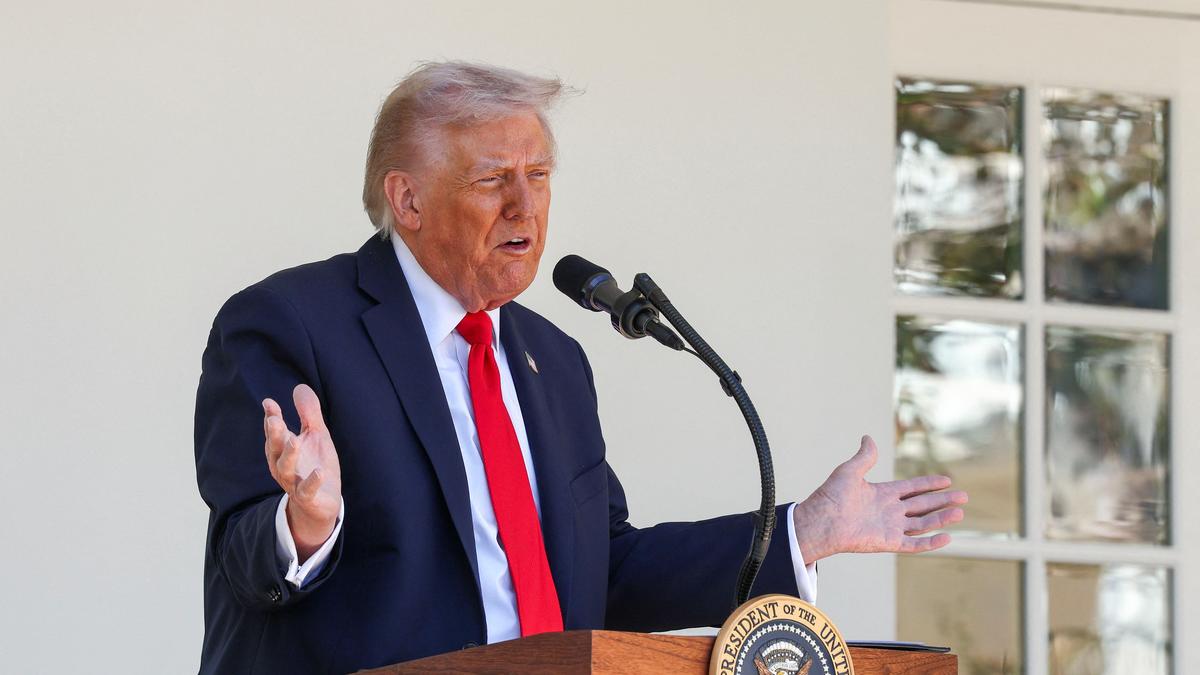
Former U.S. President Donald Trump has taken a hardline stance on the Israel–Hamas conflict, declaring that the militant group “must disarm or be disarmed, perhaps violently” if it refuses to cease its armed campaign. The remark, made during a recent campaign-style event, underscores Trump’s familiar position of strong support for Israel and his broader view that militant organizations must be met with uncompromising force if diplomacy fails.
A Blunt Message to Hamas
Trump’s statement came amid renewed hostilities in the Middle East, where clashes between Israel and Hamas have continued despite intermittent ceasefire efforts. He argued that the path to peace in the region lies in eliminating the threat posed by armed militant factions.
“You cannot have peace while a terrorist organization holds weapons aimed at civilians,” Trump said, emphasizing that Hamas’s continued resistance is the central obstacle to stability in Gaza and the wider region. “If they refuse to disarm voluntarily, they must be disarmed—by force if necessary.”
The comments reflect Trump’s longstanding belief in using overwhelming power as a deterrent against terrorism and insurgency. During his presidency, he frequently cited his administration’s policies in the Middle East—such as the elimination of ISIS leader Abu Bakr al-Baghdadi and the Abraham Accords—as proof that strength brings peace.
A Continuation of Trump’s Pro-Israel Stance
Trump’s remarks reaffirm his position as one of Israel’s most vocal defenders among U.S. political figures. His administration was marked by several landmark decisions favoring Israel, including the recognition of Jerusalem as Israel’s capital, the relocation of the U.S. embassy, and brokering normalization deals between Israel and several Arab nations.
He praised Israel’s right to self-defense and argued that no nation would tolerate rockets and terror tunnels from a neighboring territory. “Israel has every right to protect its people from barbaric attacks,” Trump asserted. “The world should stand with them until the threat is completely neutralized.”
Political and Global Reactions
Trump’s statement drew sharp reactions across political and diplomatic circles. Supporters hailed his remarks as a realistic acknowledgment of the threat posed by Hamas, calling for a tougher global response to militant extremism. Critics, however, accused him of fueling an already volatile situation, warning that such rhetoric could undermine diplomatic peace efforts and increase civilian suffering in Gaza.
Some analysts pointed out that Trump’s framing of the issue—“disarm or be disarmed violently”—leaves little room for negotiation, potentially complicating future peace talks. Others noted that the statement aligns with his campaign’s broader message of projecting American power and decisiveness on the global stage.
A Reflection of Broader U.S. Policy Divides
The remarks also highlight the growing divide in American political discourse regarding the Israel–Palestine conflict. While many Republicans echo Trump’s unyielding support for Israel, several Democratic leaders have called for a more balanced approach that includes humanitarian considerations for Palestinian civilians and renewed efforts toward a two-state solution.
Trump, by contrast, has consistently dismissed what he sees as “weak diplomacy” and instead champions a doctrine of deterrence through strength. His call for Hamas’s forced disarmament fits within that worldview, portraying violence as a justified response to terror.
Implications for the Region
If implemented as policy, Trump’s stance would likely support an aggressive Israeli military campaign aimed at fully dismantling Hamas’s military infrastructure. Such an approach could have far-reaching implications for regional stability, potentially drawing in other actors such as Hezbollah, Iran, and Egypt.
However, Trump’s supporters argue that his approach could also restore deterrence and send a strong message that terrorism will not yield political gains. They point to his tenure as one of relative calm in U.S.–Israel relations, marked by fewer large-scale escalations compared to previous administrations.
Conclusion
Donald Trump’s declaration that “Hamas must disarm or be disarmed, perhaps violently” is both a reaffirmation of his unwavering support for Israel and a reflection of his broader philosophy of peace through strength. The statement has reignited debate over the balance between security and diplomacy in the Middle East—a debate that continues to shape global politics.
As the conflict persists and international calls for restraint grow louder, Trump’s words underline a stark reality: his vision for Middle East peace remains rooted not in negotiation, but in the decisive defeat of those who threaten it.
Comments are closed.