
Jaishankar Tells China: No Role for Third Parties in India-China Ties, Urges Border Stability and Trade Predictability

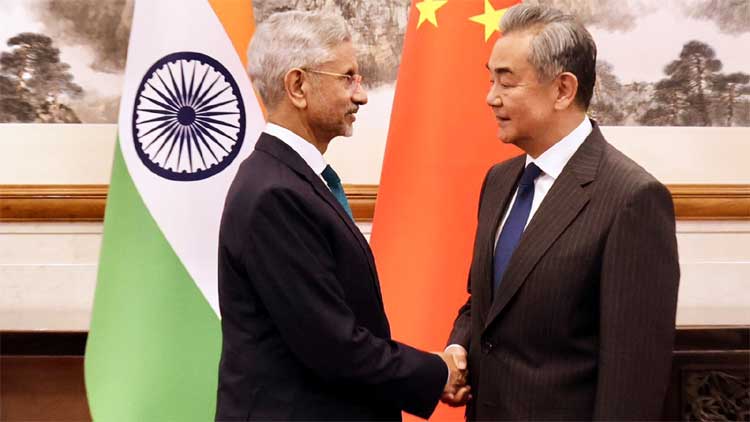
External Affairs Minister S. Jaishankar, in a meeting with Chinese Foreign Minister Wang Yi on July 14, firmly asserted that there is no place for third-party involvement—implicitly referring to Pakistan—in shaping the evolving bilateral relationship between India and China, especially in the aftermath of the 2020 PLA transgression in eastern Ladakh.
During the dialogue, held amid ongoing efforts to reset ties strained by the military standoff, Jaishankar expressed satisfaction over the resumption of Indian Army patrols in the Depsang Plains and Demchok following the October 2024 disengagement agreement. He emphasized that a stable and peaceful border is the foundation of normalized relations between the two Asian powers.
“A stable border is the lynchpin of a stable relationship,” Jaishankar reportedly told Wang, urging both militaries to focus on de-escalation five years after the Galwan Valley clash and continuing troop buildup.
Currently, over 50,000 troops and heavy weaponry remain deployed by both sides along the 1,597-km Line of Actual Control (LAC) in Eastern Ladakh, underlining the lingering tensions despite multiple rounds of talks.
Trade and Supply Chains in Focus
Jaishankar also raised concerns over China’s recent export restrictions on critical minerals essential for sectors such as automotive manufacturing and fertilizers, urging Beijing to ensure predictable and reliable supply chains to India. The restrictions have impacted the availability of rare earth elements used in magnets, as well as potassium-nitrogen fertilizers.
He called on China to avoid leveraging trade as a pressure tool, especially at a time when both countries are looking to recalibrate economic engagement.
No Place for Third Parties
In a pointed remark that holds strategic weight, Jaishankar stressed that “third countries should not define the India-China bilateral dynamic.” This appears to be a veiled reference to China’s close military cooperation with Pakistan, which has included the supply of advanced aircraft, drones, and missile systems. Much of this arsenal was showcased during Pakistan’s recent Operation Sindoor.
The emphasis on excluding third-party interests reflects India’s concern that China-Pakistan military alignment may undercut regional stability and impede the normalization of India-China ties.
Terrorism Takes Center Stage at SCO
A day prior, on July 13, Jaishankar also addressed the Shanghai Cooperation Organisation (SCO) Foreign Ministers’ meeting, where counterterrorism took precedence. He reiterated that the SCO was established to combat the “evils of terrorism, separatism, and extremism.”
Referring to India’s retaliatory strikes on terror camps in Pakistan, he said these actions were fully supported by the UN Security Council Resolution 16050, passed unanimously—including by Pakistan, China, and Russia—after the Pahalgam terror attack.
The resolution empowers nations to hold “perpetrators, financiers, and sponsors” of terrorism accountable and specifically condemned the Pahalgam attack as a serious threat to global peace and security.
Jaishankar’s remarks, across both meetings, underscore India’s dual-track approach of seeking measured normalization with China while maintaining a zero-tolerance policy on terrorism and external interference, particularly from Pakistan.
Comments are closed.