
Canadian PM Carney Highlights Fentanyl Progress Amid Trump’s Tariff Threat

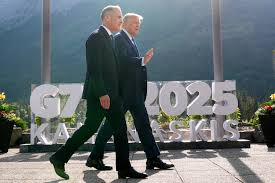
Canadian Prime Minister Mark Carney responded to U.S. President Donald Trump’s announcement of a 35% tariff on Canadian goods, set to take effect on August 1, 2025, by emphasizing Canada’s “vital progress” in combating the fentanyl crisis. The tariff, an escalation from a previous 25% levy, was justified by Trump as a response to Canada’s alleged role in allowing fentanyl and illegal immigration across the U.S. border. Carney’s statement, posted on X, reaffirmed Canada’s commitment to working with the United States to address the opioid epidemic, while also defending Canadian economic interests. This development highlights the intersection of trade policy, public health, and diplomacy in Canada-U.S. relations.
Background of the Tariff Threat
The fentanyl crisis, a major public health issue in North America, has been a contentious point in U.S.-Canada relations. In February 2025, Trump first accused Canada of enabling the flow of fentanyl and illegal immigration across the northern border, leading to the imposition of a 25% tariff on Canadian goods. On July 10, 2025, Trump announced an increase to 35%, citing Canada’s alleged failure to curb drug trafficking. In a letter to Carney posted on Truth Social, Trump stated, “If Canada works with me to stop the flow of Fentanyl, we will, perhaps, consider an adjustment to this letter,” suggesting that the tariff could be reconsidered if Canada strengthens its drug enforcement efforts.
The tariff is part of a broader U.S. strategy to address the fentanyl crisis, which has resulted in over 75,000 overdose deaths annually in the U.S. alone. Trump has linked the tariffs to national security, invoking the International Emergency Economic Powers Act (IEEPA) to justify measures against Canada, Mexico, and China, which he claims are key players in fentanyl smuggling. However, experts and Canadian officials, including former Prime Minister Justin Trudeau, have disputed Canada’s role, noting that less than 1% of fentanyl entering the U.S. comes from Canada, with the vast majority originating from Mexican cartels.
Carney’s Response and Canada’s Efforts
In response to Trump’s tariff threat, Carney took to X on July 10, 2025, stating, “Canada has made vital progress to stop the scourge of fentanyl in North America. We are committed to continuing to work with the United States to save lives and protect communities in both our countries.” He also emphasized Canada’s steadfast defense of its workers and businesses during ongoing trade negotiations, noting efforts to strengthen global trading partnerships.
Carney’s claim of progress is supported by increased Canadian efforts to combat domestic fentanyl production and trafficking. A recent study highlighted a growing presence of Mexican cartels operating fentanyl synthesis labs in Canada, prompting the Canadian government to enhance law enforcement measures. These efforts include cooperation with U.S. authorities to target cross-border trafficking networks. Despite these steps, U.S. Customs and Border Protection reported seizing only 31 pounds of fentanyl at the northern border in 2025, a fraction compared to the 97% of seizures occurring at the U.S.-Mexico border.
Trade Negotiations and Diplomatic Context
The tariff escalation comes amid strained trade negotiations between the U.S. and Canada, initially aimed at reaching a deal by July 21, 2025, but now extended to August 1 due to ongoing disputes. Carney, who assumed office in March 2025, has maintained a more cordial relationship with Trump compared to his predecessor, Justin Trudeau, who faced similar tariff pressures. During a May 2025 White House visit, Carney firmly stated that Canada was “not for sale,” responding to Trump’s provocative suggestion that Canada could become the “51st state.”
The 35% tariff, announced alongside levies on other nations, threatens to disrupt Canada’s economy, where trade accounts for 67% of GDP. In response, Carney has emphasized building a unified Canadian economy, with collaboration between federal, provincial, and territorial governments to bolster economic resilience. Posts on X reflect mixed sentiments, with some users like @matjendav4 questioning whether Carney’s cooperative tone signals a concession to Trump’s demands, while others, such as @meawwcom, view the tariffs as a potential “wake-up call” for stronger border security measures.
The Fentanyl Crisis and Misinformation
The fentanyl crisis remains a critical issue, with U.S. data indicating a peak of 114,000 overdose deaths in 2022-2023, though fatalities have dropped by over 21% since June 2023, falling below 90,000 annually. Trump’s claims, including assertions that fentanyl has killed “tens of millions” of Americans, have been debunked by experts, who note that total overdose deaths are significantly lower. Furthermore, Canada’s role in fentanyl smuggling is minimal, with experts agreeing that Mexican cartels are the primary source.
Carney’s response counters Trump’s narrative by highlighting Canada’s proactive measures, including increased cooperation with U.S. law enforcement. Mexican President Claudia Sheinbaum has similarly noted a 50% reduction in fentanyl seizures at the U.S.-Mexico border, reflecting improved enforcement efforts. These developments suggest that the fentanyl crisis is improving, raising questions about the necessity of Trump’s tariffs as a tool for drug enforcement.
Economic and Political Implications
The 35% tariff poses significant risks to Canada’s economy, potentially increasing costs for consumers and disrupting industries reliant on U.S. markets, such as automotive and energy sectors. Economists warn that Trump’s broader tariff strategy, including levies on China and Mexico, could spark a global trade war, raising prices for U.S. consumers and straining alliances. For Canada, the tariffs exacerbate existing economic pressures, prompting Carney to diversify trade partnerships globally to mitigate reliance on the U.S. market.
Politically, Carney faces the challenge of balancing domestic pressures to protect Canadian interests with the need to maintain cooperative relations with the U.S. His predecessor, Justin Trudeau, publicly refuted Trump’s fentanyl claims, while Carney has adopted a more diplomatic tone, possibly to preserve negotiation leverage. The August 1 deadline looms as a critical juncture, with the outcome likely to shape Canada-U.S. relations and the broader North American trade landscape.
Canadian Prime Minister Mark Carney’s assertion of “vital progress” in combating fentanyl reflects a strategic response to U.S. President Donald Trump’s 35% tariff threat, set to take effect on August 1, 2025. By highlighting Canada’s efforts to address the fentanyl crisis and reaffirming commitment to bilateral cooperation, Carney seeks to defuse tensions while defending Canadian economic interests. The tariff dispute, rooted in exaggerated claims about Canada’s role in fentanyl trafficking, underscores the complex interplay of trade, public health, and diplomacy. As Canada and the U.S. approach the August 1 deadline, Carney’s diplomatic approach will be tested, with implications for North American economic stability and the ongoing fight against the opioid epidemic.
Comments are closed.