
Greenland Heatwave 17x Worse Due to Climate Crisis; Arctic Ice Melt Linked to Extreme Rain in South Asia

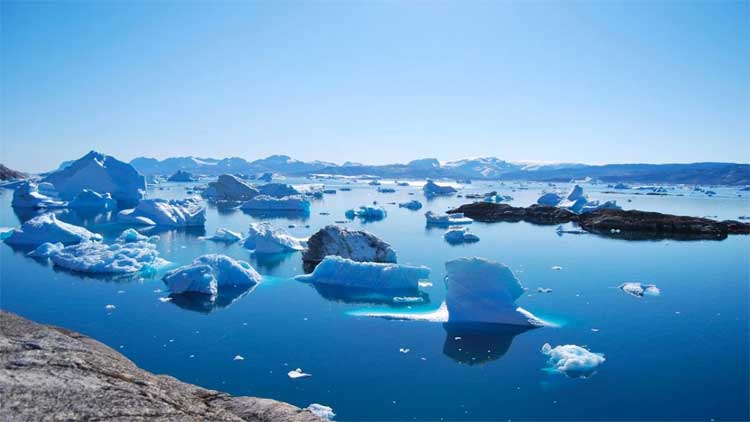
A record-breaking heatwave that caused Greenland’s ice sheet to melt at 17 times the normal rate was made 3°C hotter due to climate change, according to a new analysis by the World Weather Attribution (WWA) group released Wednesday. The same week, Copernicus Climate Change Service confirmed that May 2025 was the second-warmest May globally, with average surface air temperatures reaching 15.79°C, or 0.53°C above the 1991–2020 norm.
WWA’s study found that the seven-day extreme heat event in Iceland was 3°C warmer due to human-caused global warming, and similar heatwaves could become 2°C more intense if global temperatures rise to 2.6°C — a level projected by 2100 without urgent emissions cuts.
In eastern Greenland, May’s hottest day was 3.9°C above pre-industrial temperatures, triggering a melt rate 17 times higher than average, according to early findings from the National Snow and Ice Data Center.
“This is the largest May heatwave we’ve ever recorded — even in stations with over a century of data,” said Halldór Björnsson of the Icelandic Meteorological Office. Iceland’s automated monitoring stations — in operation for two to three decades — reported new temperature records at 94% of sites. At Stykkishólmur, with over 174 years of reliable data, historical records were broken.
Global Warming and Arctic Amplification
The Arctic is warming at more than twice the global average, driven by a feedback loop known as Arctic amplification. As reflective sea ice melts, it is replaced by darker ocean waters that absorb more sunlight, further accelerating warming.
This intense spring heat poses health risks for vulnerable populations in Iceland and undermines the safety and livelihood of Indigenous communities in Greenland, the report warned.
Wider Impact: Arctic Melt Linked to Monsoon Extremes in India
New research led by the Indian Institute of Tropical Meteorology and published in IOPScience has linked Arctic sea-ice decline to increased extreme rainfall events in South Asia, including India. Using climate models and observational data, the study found that a seasonally ice-free Arctic intensifies atmospheric circulation, boosting heavy rainfall during the Indian monsoon.
Examples include the devastating floods in Kerala (2018) and Uttarakhand (2013), both of which saw rainfall exceeding 150mm/day over small areas — the benchmark for extreme events.
The study explained that Arctic melting influences mid-latitude weather patterns, strengthens subtropical high-pressure systems over East Asia, and can trigger La Niña-like effects, which in turn enhance monsoon rainfall over India.
“As Arctic warming accelerates, the frequency of extreme precipitation events over South Asia is projected to rise,” the researchers concluded.
Experts Warn of Far-Reaching Consequences
“There is now growing evidence that Arctic sea ice melt has serious implications for the Indian monsoon,” said M. Rajeevan, former secretary at India’s Ministry of Earth Sciences. “Both observational data and model simulations confirm this link — affecting not only average monsoon behavior but also extremes.”
Meanwhile, sea surface temperatures remained abnormally high in May, with marine heatwaves recorded across the northeast North Atlantic and the Mediterranean — another sign of a warming world increasingly shaped by fossil-fuel-driven climate change.
Comments are closed.