
1,100 Trees Felled, 150 Tribal Families Left Out: Inside Maharashtra’s Rs 13,505-Crore Hydropower Project

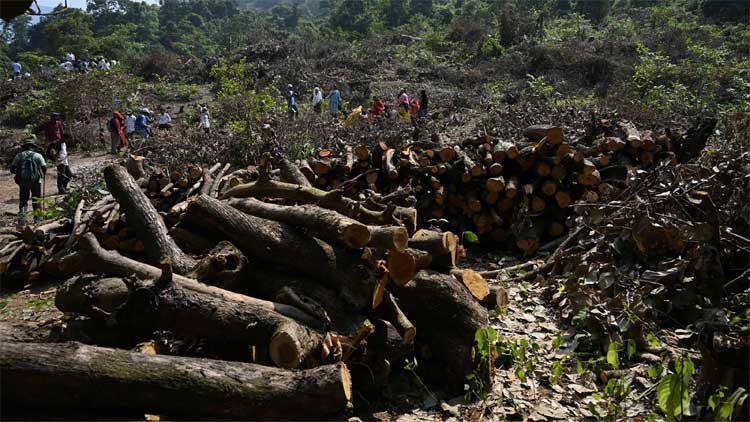
Nearly 1,100 trees have already been cut on Saidongar hill in Raigad district to make way for a 3,000-MW pumped-storage hydropower project. While the project promises cleaner energy, it has raised serious concerns over forest conservation, tribal livelihoods and the implementation of forest rights.
The numbers marked in chalk on the trees of Saidongar hill remain visible on the stumps scattered across the forest. Nearly 100 km from Mumbai, the hill in Maharashtra’s Raigad district has witnessed the felling of around 1,100 trees before the operation was temporarily stopped following protests by local villagers.
The cut trunks now lie in heaps inside the forest, guarded by officials. Villagers who have depended on these trees for firewood and other forest produce for generations are no longer allowed to collect even the wood left behind.
“For the time being, we are selling the stock of firewood that we had collected and kept aside for sale last week. Once this stock is exhausted, we do not know how we will sustain ourselves,” said Vishnu Shankar Pawar, 52, a resident of Pali village.
The tree-felling began on Dussehra morning to clear land for a proposed 3,000-MW pumped-storage hydropower project being developed by Torrent Power. The operation was halted after protests by villagers attracted opposition leaders and activists to Karjat.
The project, estimated to cost Rs 13,505 crore, is expected to become operational by 2029. It will store electricity by pumping water uphill and releasing it through turbines during periods of high demand. Spread across 377 hectares of the Sahyadri range, the project will require the removal of more than 32,000 trees.
While the project is expected to reduce Maharashtra’s dependence on coal-based electricity, its environmental and social consequences have raised concerns. The affected forest falls within an area previously identified for the highest level of ecological protection by a Western Ghats expert panel. Scientists have also warned that large-scale deforestation could disrupt moisture cycles that influence rainfall across distant regions.
More importantly, an investigation by The Indian Express found that tribal families dependent on the forest were not officially recorded as forest-dependent communities. As a result, the project received clearance on the understanding that no families or villages would require rehabilitation.
A forest that sustains entire communities
Named after the local village deity, Saidongar is a hillock in the 1,600-km Sahyadri range, part of the Western Ghats that stretches across six states along India’s western coast.
Six hamlets—Saidongar, Dhak, Pali, Potal, Ambot and Bhaliwadi—are located along its ridges. Of the 377 hectares required for the project, 233 hectares belong to the Forest Department, while the remaining 144 hectares fall within these hamlets.
At the foothills flows the Pej river, which will supply water for the hydropower project. However, the river has largely dried up this year, exposing stretches of black rock due to poor rainfall.
Around 150 families, most belonging to the Katkari tribal community, live across the six hamlets. For generations, their lives and livelihoods have been closely connected to the forest.
Every morning, villagers collect firewood, bundle it and carry it to nearby markets, earning between Rs 150 and Rs 200 a day. They also collect honey, mahua, jamun and guava, both for household consumption and sale.
With access to the forest now restricted, these families face the loss of an important source of income and food.
The forest also serves as a traditional source of medicine. Villagers collect neem, gulvel (giloy) and adulsa (Malabar nut), which they use to treat fever, respiratory problems, dental ailments and wounds.
Nana Barku, 72, a community leader, recalled how villagers relied on forest resources during the Covid-19 pandemic in 2020.
“We consumed Gulvel leaves, which we believed helped boost our immunity, and not a single person in our community was affected. Just as an urban dweller may find it difficult to survive in the forest, a tribal community like ours cannot survive without the forest. If the forest is gone, our way of life will be gone with it,” he said.
The Pej river has traditionally provided another source of livelihood. During the monsoon, villagers catch fish and crabs and sell them in local markets. However, with the river drying up due to deficient rainfall, the forest has become their primary source of sustenance until the next monsoon.
Tribal families left out of the Forest Rights Act process
The Forest Rights Act, 2006, recognises the rights of communities living in and depending on forest areas. It allows them to claim land and resources that they have traditionally used for collecting forest produce and sustaining their livelihoods.
Under Section 6 of the Act, the Gram Sabha, or village assembly, is responsible for initiating the process, receiving and verifying claims, and forwarding its recommendations to the Sub-Divisional Level Committee for consideration.
Forest land should not be diverted for development projects until the relevant forest rights have been recognised and settled.
However, in Pali, the process was never completed.
According to Forest Department officials, the Gram Sabha did not submit records identifying the families dependent on the forest. In the absence of such documentation, officials said, the department proceeded on the basis that no families required compensation or rehabilitation.
The environmental clearance granted to Torrent Power by the Union Ministry of Environment, Forest and Climate Change (MoEFCC) also states that no rehabilitation of families or villages is envisaged under the project.
Consequently, around 150 families across the affected hamlets risk losing access to forest resources without receiving compensation for the livelihoods they have depended on for generations.
Sameer Shinde, Range Forest Officer, Karjat, said the Gram Sabha was required to document the number of tribal families dependent on the forest, along with details of the areas where they cultivate crops, collect forest produce and gather medicinal plants.
The Forest Department would then verify the claims and determine eligibility for rehabilitation and compensation.
“However, in this case, the Sabha did not maintain any records, nor did it submit any recommendations regarding compensation. We have held multiple public hearings over an 18-month period, attended by more than 400 people. Many of them raised the issue of harvesting produce from forest land, and we encouraged the Sabha to submit a formal record. However, the records never came to us, and without them, we cannot process any compensation or rehabilitation,” Shinde told The Indian Express.
Pali sarpanch Balu Pawar was unavailable for comment.
Forest records also indicate that tree-felling began without a no-objection certificate from the Pali gram panchayat.
Shinde maintained that such permission was not required. “The Forest Department does not require an NOC from the Panchayat to begin tree-felling. We only need the MoEFCC clearance, which has already come through,” he said.
He added that the suspension of tree-felling was temporary and that no decision had been taken on when the operation would resume.
“The drive was stopped temporarily to ensure that the law and order situation in the village is maintained,” he said.
Ecologically sensitive Western Ghats under pressure
The environmental concerns surrounding the project extend beyond the immediate loss of trees.
In 2010, the MoEFCC established the Western Ghats Ecology Expert Panel, headed by ecologist Madhav Gadgil, to assess the ecological sensitivity of the mountain range and recommend appropriate protection measures.
The panel submitted its report in August 2011, identifying 10 districts in Maharashtra as part of the ecologically sensitive Western Ghats. It classified the region into three categories: ESZ 1, requiring the highest level of protection; ESZ 2, allowing development under moderate restrictions; and ESZ 3, permitting regulated and sustainable development.
According to the panel’s recommendations, Pali village in Karjat taluka, where the hydropower project is located, fell within ESZ 1. This category was intended to receive the strongest environmental protection, with restrictions on activities such as large dams, mining and major infrastructure projects.
However, the panel’s recommendations were never implemented. A subsequent expert panel proposed a smaller protected area, while the final notification has undergone several drafts over the years.
The Bhimashankar forest, which is also classified as ESZ 1, lies 15.5 km from the project site, according to the project’s environmental clearance report.
The proposed hydropower plant highlights a difficult question facing Maharashtra: how can the state meet its growing energy requirements without destroying ecologically sensitive forests and the livelihoods of communities that have depended on them for generations?
For the families of Saidongar, the answer is immediate and deeply personal. The trees that once provided fuel, food, medicine and income are disappearing, while the future of their traditional way of life remains uncertain.
Editorial note: This version retains the supplied reporting and quotations while improving readability and narrative flow. The claims about forest rights, ecological classification and project clearances should be independently verified before publication.
Comments are closed, but trackbacks and pingbacks are open.