
Zohran Mamdani’s NYC Win Reverberates Globally: Indian-Origin Mayor Takes Aim at Modi, Trump and the Right Wing

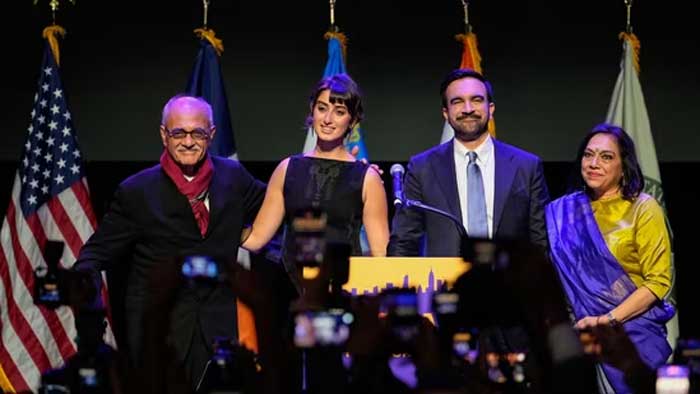
The election of 34-year-old Zohran Mamdani as the next mayor of New York City has sent ripples through political circles in both the United States and India. The first Muslim and first Indian-origin leader of America’s largest city, Mamdani represents a multiracial, socialist and unapologetically progressive politics that stands in sharp contrast to the era defined by Donald Trump — and, he says, Narendra Modi.
Born in Uganda to an Indian-origin scholar father and acclaimed Indian filmmaker Mira Nair, Mamdani embraces a hybrid identity that is as much global as it is personal. But unlike many diaspora politicians who steer clear of Indian politics, Mamdani has not hesitated to openly criticise Prime Minister Modi and the BJP, accusing them of promoting a “majoritarian, anti-Muslim” vision of India.
Taking on Modi, and BJP Strikes Back
In multiple speeches, Mamdani has compared Modi with Trump and Israel’s Benjamin Netanyahu — leaders he describes as champions of exclusionary politics. He has labelled Modi “fascist”, a word his mother, Mira Nair, has also used publicly. Mamdani’s critique is rooted in what he calls a betrayal of the “pluralistic” India he grew up believing in.
“We were raised with the idea of an India where everyone belonged,” he said, contrasting that with what he views as the BJP’s Hindutva-centred idea of citizenship.
The reaction from BJP circles in India was swift. Mumbai party leader Ameet Satam said he would “not tolerate any Khan leading the city”, while BJP MP and actor Kangana Ranaut accused Mamdani of “sounding more Pakistani than Indian”.
Nehru Quote Sparks New Flashpoint
In his victory speech, Mamdani invoked Jawaharlal Nehru’s iconic “Tryst with Destiny” address, marking a rare moment when Indian Independence-era rhetoric resurfaced in American politics.
“Tonight we have stepped from the old into the new,” he said, echoing Nehru — a gesture that drew praise from India’s Opposition Congress. Priyanka Gandhi said Mamdani’s reference showed Nehru’s global stature “despite BJP’s attempts to erase him”.
A Campaign Steeped in Pop Culture, Faith Diversity
Mamdani’s bid for the mayoralty did not shy away from South Asian cultural references — from playing Bollywood hits at rallies to humorously sharing “mouth freshener” on camera. He visited gurdwaras, mosques, and temples, and even referenced Amitabh Bachchan in campaign videos.
“He didn’t run away from his heritage — he brought it into the room,” said US Congressman Ro Khanna.
Before entering politics, Mamdani was briefly a rapper who sang about chapatis and immigrant identity. Today, those songs still earn him about $1,000 a year, a quirky footnote to his current $142,000 public salary.
Policy Platform: Pro-Immigrant, Pro-Worker
Running as a Democratic Socialist, Mamdani campaigned on rent freezes, free public buses and government-subsidised grocery stores — policies critics called “socialist fantasy” and supporters hailed as “economic justice”.
“We will make sure New York remains a city of immigrants,” he said from the podium after his win.
Trump vs Mamdani: The New Frontline
His campaign drew national attention not only because of his heritage, but because of who opposed him. Donald Trump repeatedly attacked Mamdani, calling him a “communist” and “Jew hater” over his stance on Palestine. Mamdani responded directly after winning:
“Donald Trump, since I know you’re watching — I have four words for you: Turn the volume up.”
Islamophobia Couldn’t Stop Him
Despite online hate campaigns, Mamdani won comfortably. For many South Asian Americans, his victory symbolised something larger: that a Muslim, South Asian, pro-Palestine socialist could win the highest office in a city still marked by the memory of 9/11.
One analyst called it “a full-circle moment for New York — from suspicion of brown immigrants to electing one as mayor”.
In India, the debate is not about rent control or subway fares — but identity.
For one side, Mamdani is a proud example of the Indian diaspora’s global success.
For the other, he is a “Hinduphobic leftist who insulted Modi”.
With elections due in both India and the US in 2026, this may only be the opening act of a much larger political argument — one that spans continents, religions and ideas of nationhood.
Comments are closed.