
World welcomes 2026 with fireworks after a year of turmoil

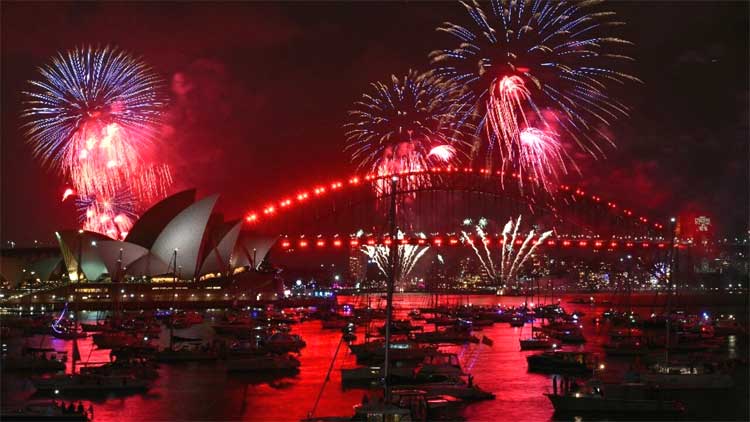
People around the world rang in 2026 on Wednesday, bidding farewell to 2025 — one of the hottest years on record and a year marked by war, political upheaval and fragile hopes for peace.
In Russia, President Vladimir Putin used his traditional New Year address to hail the country’s military “heroes,” saying they would secure victory in Europe’s deadliest conflict since World War II. Across the border, Ukrainian President Volodymyr Zelensky said his country was “10 percent” away from an agreement to end the fighting, though the war continued to dominate daily life.
New Year celebrations in Sydney took on a somber tone, with revellers observing a minute of silence for victims of the Bondi Beach shooting before nearly nine tonnes of fireworks illuminated the harbour at midnight. Heavily armed police patrolled crowds barely two weeks after Australia’s deadliest mass shooting in almost 30 years.
In Moscow, pensioner Natalia Spirina said she hoped 2026 would bring an end to what authorities call Russia’s “special military operation.” “I want the guys to come home and for peace and stability to finally be established,” she said. In Ukraine’s Vyshgorod, beauty salon manager Daria Lushchyk said the war had made her work “hell,” but added that clients kept coming regardless. “Nothing can stop our Ukrainian girls from getting glam,” she said.
Pacific nations including Kiribati and New Zealand were the first to welcome the new year, followed by celebrations in Asia, Europe and the Americas. More than two million people were expected to gather on Rio de Janeiro’s Copacabana Beach for what authorities billed as the world’s largest New Year’s Eve party. In Hong Kong, however, a major fireworks display was cancelled in tribute to 161 people killed in a deadly apartment fire in November.
Truce and tariffs
The year 2025 delivered a mix of anxiety, spectacle and tragedy. Donald Trump returned to the White House in January, unleashing sweeping tariffs that rattled global markets. Using his Truth Social platform, he celebrated his policies despite sliding approval ratings ahead of November’s US midterm elections.
After two years of devastating war in Gaza, US-brokered pressure led to a fragile ceasefire between Israel and Hamas in October, though both sides have accused each other of repeated violations. “We bid farewell to 2025 with deep sorrow,” said Gaza City resident Shireen Al-Kayali, citing widespread loss, displacement and fear.
Elsewhere, Syrians in Damascus marked a year since the fall of Bashar Assad with cautious optimism. “There is no fear, the people are happy,” said marketing manager Sahar Al-Said. “I hope we will love each other — that is enough,” added Bashar Al-Qaderi.
The year also saw offbeat global trends, from the viral rise of Labubu dolls to the long-awaited return of K-pop group BTS. The world lost pioneering zoologist Jane Goodall, the Vatican elected its first American pope, and the assassination of right-wing activist Charlie Kirk highlighted deep political divisions in the United States.
Sports, space and AI
In Dubai, thousands queued for hours to witness a fireworks and laser spectacle at the Burj Khalifa, the world’s tallest building, as pyrotechnics and LED displays lit up the 828-metre tower.
Looking ahead, 2026 promises major milestones in sports, space and technology. NASA’s Artemis II mission is set to send astronauts around the moon for the first time in more than half a century. Artificial intelligence faces growing scrutiny amid fears the sector’s explosive growth could be forming a market bubble.
Athletes will gather in Italy for the Milano Cortina Winter Olympics in February, while the world’s largest football World Cup — featuring 48 teams — will take place in the United States, Mexico and Canada in June and July.
Comments are closed.