
Why ASEAN and China Should Forge a Joint Climate Compact

With the next round of annual global climate talks approaching, the European Union and China last month issued a joint declaration pledging to submit 2035 emissions targets, speed up green technology deployment, and uphold the Paris Agreement’s principles of multilateral climate governance.
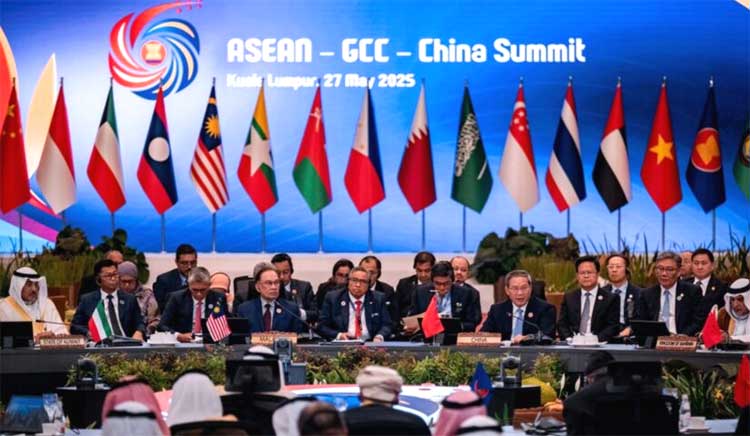
That kind of partnership shouldn’t be limited to two major powers — ASEAN and China should follow suit with their own jointly designed, Paris-aligned climate compact.
A Strong Foundation, But Gaps Remain
China and ASEAN already cooperate on clean energy, climate resilience, and sustainable agriculture. They reaffirm their commitment to the UN Framework Convention on Climate Change and embrace the principle of “common but differentiated responsibilities,” with pledges on capacity building, technology transfer, and financing for mitigation and adaptation. China has promised support for the ASEAN Centre for Climate Change and projects in low-carbon communities and climate-resilient cities.
Yet there’s no binding ASEAN-China emission pledge, no coordinated sectoral targets, and no shared results-tracking system. In contrast, the EU-China statement is precise — committing to all-sector, all-gas 2035 targets ahead of COP 30. ASEAN’s fragmented national pledges lack coherent timelines and coordination.
The Case for a Compact
A joint ASEAN-China climate compact could:
-
Synchronise national trajectories and coordinate emission reduction timelines.
-
Leverage financial and technical cooperation for renewable energy, storage, and transmission infrastructure.
-
Set shared reporting protocols to boost accountability.
ASEAN’s work on cross-border renewable energy trade, including the revival of the ASEAN Power Grid, could be accelerated under such a compact. Agricultural cooperation — already targeting low-carbon, circular, and smart-farming practices — could be consolidated and explicitly linked to emissions and adaptation goals.
Diplomatic Leadership in a Fragmented World
The EU and China’s climate declaration in July showed that climate action can transcend trade disputes, geopolitical tensions, and resource competition. ASEAN and China could send a similar signal, elevating ASEAN from a passive platform to an active partner in global climate diplomacy.
Critics may cite ASEAN’s preference for non-interference and slow movement on binding treaties — as seen with the long-delayed haze agreement. But the emerging ASEAN Centre for Climate Change provides a home for coordinated action while preserving ASEAN centrality.
The Time Is Right
ASEAN’s COP 29 collective statement reaffirmed Paris goals and highlighted the slow pace of global climate finance and emissions cuts. Dialogue with China already covers sustainable development, clean energy, and capacity building. What’s missing is a concrete, dated, and measurable deliverable ahead of COP 30 in Brazil.
ASEAN’s exposure to coastal storms, extreme heat, supply chain disruptions, and food insecurity makes climate cooperation urgent. China’s climate diplomacy resources and ASEAN’s growing institutional capacity create the conditions for success.
A joint ASEAN-China climate compact could transform aspirations into operational ambition — moving from fragmented national action to aligned regional leadership. Just as the EU and China have used climate cooperation as a stabilising force, ASEAN and China can step forward together, proving Southeast Asia is not only a region at risk, but a region of climate governance.
Comments are closed.