
Warming in High Mountains, Including Himalayas, Nearly 50% Faster Than Global Average Since 1950: Study

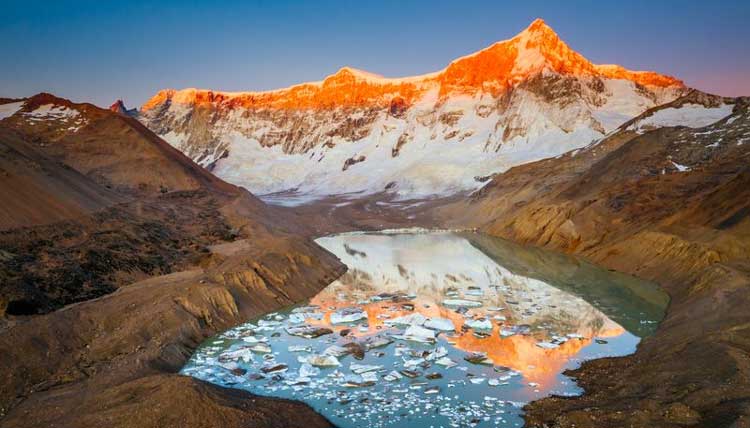
Warming at high mountain elevations — including the Himalayas — may be occurring about 50% faster than the global average since 1950, posing serious risks for more than a billion people who depend on these regions for water and ecological stability, according to a new study.
Published in Nature Reviews Earth and Environment, the research finds that mountains worldwide are experiencing significantly sharper climate shifts than lowland areas. From 1980 to 2020, mountains saw enhanced warming of 0.21°C per century, increased drying of 11.5 mm per century, and accelerated snow loss of 25.6 mm per century.
The international team led by the University of Portsmouth examined “elevation-dependent climate change,” where warming speeds up with altitude. Key drivers include changes in surface albedo, specific humidity, and aerosol levels.
“Mountains share many characteristics with the Arctic and are undergoing similarly rapid changes,” said lead researcher Nick Pepin. “Snow and ice loss is accelerating, ecosystems are shifting, and at higher elevations the rate of climate change can intensify even further.”
However, Pepin noted that the most rapid changes don’t always occur at the highest peaks. Mid-elevation zones — where snowlines are retreating — are often the most vulnerable. Aerosols from industrial and agricultural regions, such as those in India and China, also contribute to faster snow and ice melt by settling on high-altitude surfaces.
Researchers analysed global datasets and case studies from ranges including the Alps, the Tibetan Plateau, and High Mountain Asia. They found that positive elevation-dependent warming is consistent across long time periods despite regional variations. Climate models also project continued warming of around 0.13°C per century in mountain regions through the 21st century, though precipitation trends remain uncertain.
The consequences extend globally. More than a billion people rely on mountain snow and glaciers for water, including major populations in India and China. Rapid Himalayan ice loss could increase the risk of severe flooding as snowfall increasingly shifts to rain.
“As temperatures rise, plants and animals are moving uphill in search of cooler habitats,” Pepin said. “But eventually, some species will simply run out of mountain. With nowhere left to go, ecosystems may be fundamentally altered.”
Comments are closed.