
War-Torn Myanmar Turns to Solar to Weather Deepening Power Crisis

When Thailand cut power supplies to Myanmar along their shared western border earlier this year, the move was intended to crack down on online scam centers tied to human trafficking networks. But the decision also hit local communities hard, forcing hospitals, government offices, and homes to install solar panels, said Zaw, a rescue worker in Myawaddy town.
“Three out of four people now rely on solar panels, with businesses using multiple panels,” said Zaw, who withheld his full name for safety reasons.
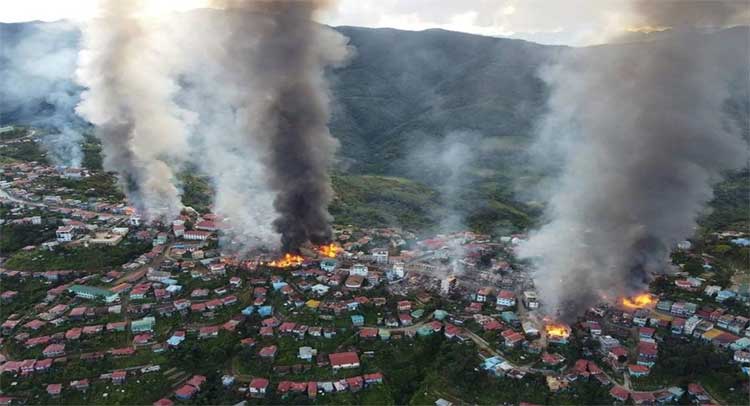
Myanmar’s electricity network has deteriorated sharply since the 2021 military coup and ongoing civil war, leaving millions facing chronic blackouts. Western sanctions have further strained the cash-starved junta, eroding its ability to maintain power infrastructure. The World Bank estimates the country’s operating power capacity plunged to 2015 levels in 2024, calling the electricity situation in conflict-hit regions “catastrophic.” Chinese companies have stepped in with affordable solar panels.
U.N. analysis of nighttime light data — a proxy for economic activity and electrification — shows an average annual decline of 8% since the coup. The World Bank attributes much of the drop to shortages of natural gas, Myanmar’s primary fuel for power generation. Domestic output has fallen, and the junta has halted liquefied natural gas imports due to a foreign exchange crunch.
The Biden administration froze roughly $1 billion of Myanmar assets and imposed sanctions, some of which the Trump administration has since eased. Western restrictions have limited access to technical expertise, spare parts, and maintenance for infrastructure such as transmission lines damaged in the conflict.
The junta acknowledged earlier this year that generation capacity has fallen to nearly half of pre-2021 levels, though figures on the Ministry of Electric Power’s website show little change in output since 2018. The information ministry and junta spokesperson did not respond to Reuters’ questions.
Amid worsening shortages, many households and businesses are turning to solar power, according to interviews with a dozen residents, business owners, and equipment sellers. “Unlike much of Asia, where corporate demand is driving solar expansion, energy security concerns and fuel shortages are the main drivers in Myanmar,” said Linda Zeng, a renewables analyst at Fitch Solutions unit BMI.
Solar panel imports from China — Myanmar’s biggest supplier — more than doubled to about $100 million in the first nine months of 2025, Chinese customs data shows. Shipments are now more than eight times higher than pre-pandemic levels.
Small solar systems are increasingly powering shops, restaurants, workshops, water kiosks, clinics, and schools, said an official with an international development agency active in Myanmar. One ice-cream vendor in Mawlamyine said he relies on solar for his 10 refrigerators because grid electricity is too unreliable.
Household installations have surged from a few hundred units in 2019 to around 300,000 in 2025, said Ken Pyi Wa Tun, chairman of Parami Energy, a seller of solar panels and diesel generators. A basic solar-battery-inverter setup costs under $1,000 and can run essential appliances — including two air-conditioners — for four to five hours, he said. While still expensive for many families, it is far cheaper than a small diesel generator priced at about $7,000, plus $50 to $100 in weekly fuel costs. He estimated solar could eventually serve 2 million to 2.5 million households.
Myanmar’s solar surge mirrors trends in other countries with unstable grids — including Pakistan, Iraq, Sri Lanka, and Afghanistan — which are now among the fastest-growing markets for Chinese-made panels, according to energy think-tank Ember.
“If the grid is not reliable or prices are too high, people will do it themselves — and now they can, thanks to solar,” said Richard Black, Ember’s director of policy and strategy.
Analysts warn that such necessity-driven adoption could disrupt traditional utilities, alter fossil fuel demand forecasts, and complicate grid management. Pakistan, for instance, has seen utilities raise tariffs for remaining customers as affluent households abandon the grid in favor of solar.
Myanmar’s diesel imports fell 11% in the first 10 months of 2025, according to energy analytics firm Kpler, even as solar panel purchases climbed.
“It’s not that we’re using solar for clean energy or environmental reasons. We’re a country in civil war. We’re using it out of necessity,” said a resident of the Bago region.
Comments are closed.