
Venezuela’s interim president to visit US amid deepening oil ties
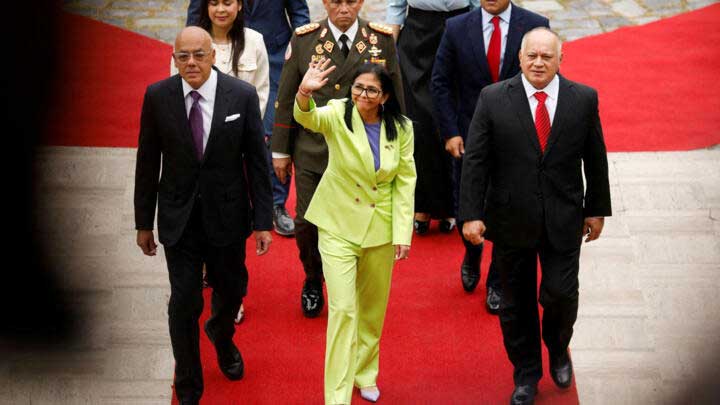
Venezuela’s interim president is expected to visit the United States soon, a senior U.S. official said on Wednesday, signaling President Donald Trump’s willingness to engage with the oil-rich country’s new leadership.
Delcy Rodríguez would be the first sitting Venezuelan president to make a bilateral visit to the United States in more than 25 years, excluding trips to attend United Nations meetings in New York.
Rodríguez said on Wednesday that she was approaching dialogue with Washington “without fear.”
“We are in a process of dialogue, of working with the United States, without any fear, to confront our differences and difficulties and to address them through diplomacy,” she said.
The invitation marks a dramatic shift in relations between Washington and Caracas following the U.S. operation in which Delta Force operatives seized then-president Nicolás Maduro in Caracas and transferred him to the United States to face narcotrafficking charges.
A former vice president and long-time insider in Venezuela’s authoritarian and anti-American establishment, Rodríguez assumed the role of interim president after breaking with Maduro. She remains under U.S. sanctions, including an asset freeze.
Despite this, and with U.S. warships still positioned off Venezuela’s coast, Rodríguez has allowed Washington to broker Venezuelan oil sales, encouraged foreign investment and ordered the release of dozens of political prisoners.
A senior White House official said Rodríguez would visit the United States soon, though no date has been set.
The last bilateral visit by a sitting Venezuelan president took place in the 1990s, before Hugo Chávez came to power. Since then, successive Venezuelan governments have openly defied Washington while strengthening ties with China, Cuba, Iran and Russia.
The prospective visit, which has yet to be confirmed by Venezuelan authorities, could prove controversial within the government. Hardliners remain wary of rapprochement with Washington, and key figures such as Interior Minister Diosdado Cabello and Defence Minister Vladimir Padrino López continue to wield significant influence. Analysts say their backing of Rodríguez is not assured.
Trump has so far appeared willing to allow Rodríguez and much of the existing power structure to remain in place, provided the United States gains access to Venezuela’s oil reserves — the largest proven reserves in the world.
Earlier this month, Trump hosted exiled opposition leader and Nobel Peace Prize laureate María Corina Machado at the White House. After initially questioning her influence over Venezuela’s security forces, Trump said on Tuesday he would “love” to see her “involved in some way.”
Machado’s party is widely believed to have won Venezuela’s 2024 elections, which Washington says were stolen by Maduro.
Analysts say Trump’s pragmatic approach reflects a reluctance to pursue wholesale regime change, citing the legacy of U.S. intervention in Iraq.
“Those kinds of intervention operations — and the deployment of troops for stabilization — have always ended very badly,” said Benigno Alarcón, a political analyst at Andrés Bello Catholic University in Caracas.
Trump’s stance has drawn criticism from democracy activists, who argue that all political prisoners must be freed, granted amnesty and that Venezuela must hold new elections.
Comments are closed.