
Venezuela’s Armed Street Groups Vow to Fight After US Raid Ousts Maduro

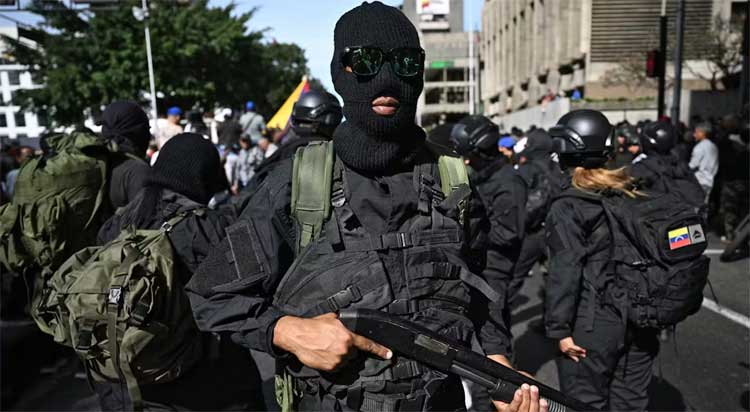
When explosions shattered the night sky and US warplanes roared over Caracas, Jorge Suarez and his companions rushed in fear to grab their guns.
For members of the colectivos—armed loyalists of Venezuela’s leftist leadership—the US raid that ousted President Nicolas Maduro marked the most dramatic challenge they had ever faced.
“We’re not used to this — it was like a best-seller, like something out of a movie,” said Suarez, wearing black sunglasses and a cap emblazoned with the slogan, “Doubt is treason.”
“We took to the streets, waiting for instructions from our leaders.”
As self-styled defenders of the socialist “Bolivarian revolution,” the fall of Maduro has left the colectivos angry, confused and convinced that he was betrayed from within.
“There is frustration, anger and a will to fight,” said a 43-year-old member of the Boina Roja (Red Beret) collective, who identified himself only as Willians.
“It’s still not really clear what happened. What is clear is that there were many betrayals.”
He pointed to what he called inexplicable failures in Maduro’s defenses.
“We don’t understand how the anti-aircraft system failed. We don’t know what happened to the rocket-launch system.”
Policing the transition
Formed in their current shape under Maduro’s predecessor Hugo Chavez, the colectivos have long acted as enforcers of order in pro-government neighborhoods, though critics accuse them of intimidating and attacking political opponents.
Following Maduro’s removal, the groups have rallied behind Delcy Rodriguez, the former vice president who has assumed the role of interim leader. Rodriguez has pledged cooperation with US President Donald Trump over Washington’s demand for access to Venezuela’s vast oil reserves, while insisting the country will not be “subordinate” to the United States.
Willians said the colectivos were resisting what he described as psychological warfare in the post-Maduro period.
“They say Trump might bomb again, or that Delcy Rodriguez is with the United States,” he said. “Those are mind games.”
Many colectivos cite Rodriguez’s ideological lineage as proof of her loyalty. She is the daughter of a far-left militant who died in intelligence custody in 1976.
“I don’t think anyone would betray her father,” said Alfredo Canchica, leader of the Fundacion 3 Raíces collective.
“You can betray the people, but not your father.”
Asked about how the transition might unfold under Trump and Rodriguez, colectivo members were guarded but defiant.
“We don’t believe the threats that the Americans are going to come, dig in and take us out,” Canchica said.
“They’ll have to kill us first.”
Maduro ‘betrayed’
Feared by opponents as a rifle-carrying, motorbike-mounted shock force, the colectivos are also welcomed in some poor neighborhoods, where residents credit them with curbing crime and distributing subsidized food.
Speaking at the Chato Candela baseball stadium in the working-class 23 de Enero district, Canchica pushed back against their violent image.
“When opposition demonstrators and some world powers accused Maduro of stealing the July 2014 election, we stopped the shantytowns from rising up,” he said.
The colectivos also say they run sports programs, coordinate with hospitals and transport networks, and monitor traders to prevent price speculation.
Yet among their ranks, the dominant emotion following Maduro’s capture is a sense of deep betrayal.
“The betrayal must have come from someone very close to our commander,” Canchica said.
“It was so perfect we didn’t notice. We still don’t know who betrayed us or how—it happened so fast.”
In his office, adorned with portraits of independence hero Simon Bolivar, Hugo Chavez and Maduro, Suarez watched online animations reconstructing the moment of Maduro’s capture. Books, bullets and a sound-wave bomb lay on the table beside him.
“It makes you angry,” he said.
“Despite all the military support from Commander Vladimir Putin, China and North Korea, how can we react in real time when the United States has technology far more advanced than ours?”
Comments are closed.