
Venezuela’s acting president calls for oil reforms to attract foreign investment
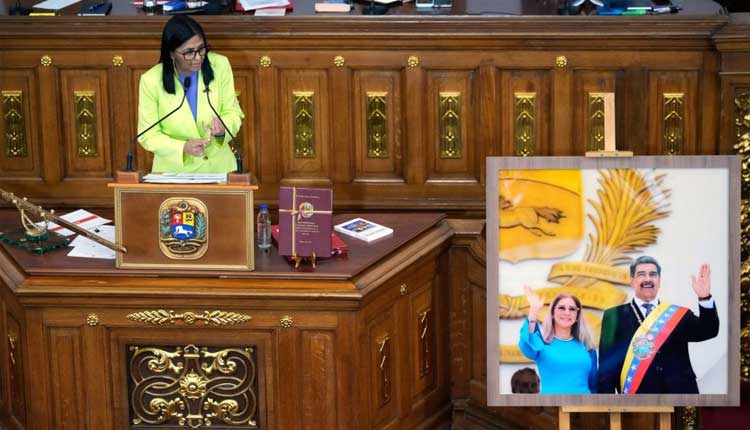
Venezuela’s acting President Delcy Rodríguez used her first state of the union address on Thursday to promote oil industry reforms aimed at attracting foreign investment — a priority aggressively pushed by the Trump administration since it toppled the country’s longtime leader less than two weeks ago.
Rodríguez, under pressure from Washington to align with US plans for the oil-rich nation, said revenue from Venezuelan oil sales would be directed toward shoring up the country’s crisis-hit health system, economic development and infrastructure projects.
While sharply criticizing the Trump administration and saying there was a “stain on our relations,” the former vice president also outlined a markedly different tone toward the United States than her predecessors, who routinely denounced American intervention.
“Let us not be afraid of diplomacy” with the US, Rodríguez said, as she seeks to navigate competing pressures from Washington and powerful domestic figures loyal to former president Nicolás Maduro.
The address, broadcast on a delay in Venezuela, came a day after Rodríguez said her government would continue releasing prisoners detained under Maduro, describing the move as part of “a new political moment” following his ouster.
On Thursday, Trump met at the White House with Venezuelan opposition leader María Corina Machado, whose party is widely seen as having won the disputed 2024 elections rejected by Maduro. However, by endorsing Rodríguez — who served as Maduro’s vice president from 2018 — Trump has effectively sidelined Machado.
Rodríguez said oil revenue would be split between two funds: one focused on social services and public health care, and another dedicated to economic development and infrastructure.
Venezuela’s health system has been crippled for years, with hospitals often requiring patients to bring their own medical supplies, from syringes to surgical equipment. Economic collapse and shortages have driven millions of Venezuelans to migrate in recent years.
Rodríguez now faces a delicate balancing act between US demands and senior Venezuelan officials who maintain control over security forces and strongly oppose Washington. Her recent speeches have reflected that tension, oscillating between conciliatory appeals for cooperation and defiant rhetoric echoing Maduro-era anti-imperialism.
US officials have long denounced Venezuela’s leadership as a “dictatorship,” while the country’s ruling establishment has cultivated a populist narrative hostile to American influence.
For now, Rodríguez is not required to call elections. Venezuela’s high court granted her presidential powers on an acting basis under a constitutional provision allowing the vice president to assume office for renewable 90-day terms.
Trump has enlisted Rodríguez to help secure US control over Venezuela’s oil sales, despite having sanctioned her for human rights violations during his first term. Earlier this month, he warned her that failure to comply could result in a “situation probably worse than Maduro.”
Maduro, who is currently jailed in Brooklyn, has pleaded not guilty to drug-trafficking charges.
Ahead of Rodríguez’s speech, supporters of the former president were allowed into the presidential palace, where they chanted in his defense. “Maduro, resist, the people are rising,” they shouted.
Comments are closed.