
Vande Mataram row: Why Congress sings only first two stanzas and what happened in 1937

The political battle over Vande Mataram has reopened an 89-year-old debate within the Indian national movement. The controversy intensified after Parliament cleared amendments to the Prevention of Insults to National Honour Act, 1971, giving Vande Mataram the same legal standing as the national anthem, Jana Gana Mana.
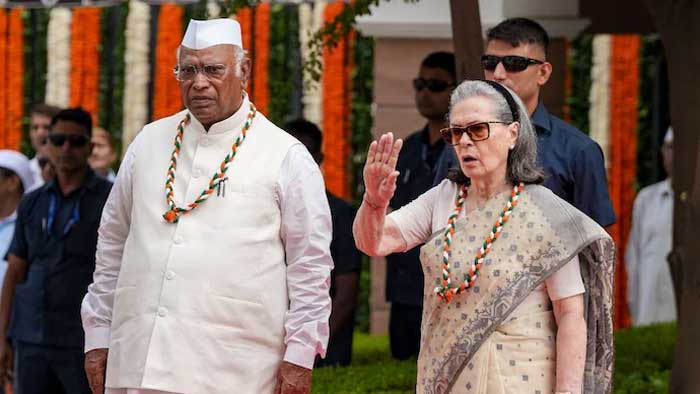
Despite the change, the Congress has said it will continue singing only the first two stanzas of Vande Mataram at its events.
The BJP has accused the party of being “anti-national”, while Congress has hit back by calling the BJP “fraudulent and fake nationalists”.
At the heart of the dispute is a decision taken by the Congress Working Committee (CWC) on October 28, 1937.
What triggered the latest controversy?
Congress MP Jairam Ramesh reignited the debate by sharing an excerpt from historian Sabyasachi Bhattacharya’s book Vande Mataram – The Biography of a Song on X.
According to the book, the CWC — which included Jawaharlal Nehru, Sardar Vallabhbhai Patel, Subhas Chandra Bose, Maulana Abdul Kalam Azad, Govind Vallabh Pant and Acharya Narendra Dev — agreed to adopt only the first two stanzas of the song at its October 28, 1937 meeting.
Ramesh said the proposal came from Rabindranath Tagore.
“It was the Gurudev himself — with his own special relationship to Vande Mataram — who suggested that the first two stanzas of the song be adopted,” Ramesh wrote.
He argued that the BJP’s criticism of Congress over the issue effectively amounted to accusing Tagore of promoting a divisive ideology.
Union Home Minister Amit Shah, however, described the 1937 decision as one taken “for the sake of appeasement”.
“It was the Congress itself that fragmented Vande Mataram into two parts,” Shah said.
Congress leader KC Venugopal rejected the charge, saying Vande Mataram and the national anthem were important to Congress but that the BJP was turning the issue into a political matter.
What is Vande Mataram?
Bankim Chandra Chattopadhyay wrote Vande Mataram in Sanskritised Bengali in 1875 and later incorporated it into his novel Anandamath. The novel was set against the backdrop of the Sanyasi Rebellion in Bengal during the late 18th century.
Rabindranath Tagore later set the verses to music.
The song became closely associated with the Indian freedom movement during the Swadeshi movement of 1905-08. In 1907, freedom fighter Madam Bhikaji Cama raised the Tricolour at Stuttgart in Germany with “Vande Mataram” inscribed on it.
Why were the later stanzas controversial?
The first two stanzas largely use pastoral and maternal imagery. They describe the motherland through images of rivers, fertile fields, crops, cool winds and moonlit skies.
The tone changes from the third stanza. The motherland is depicted using Hindu religious imagery, including references to Durga, Lakshmi and Saraswati.
The later verses therefore became a source of concern among some leaders who feared that the religious imagery could alienate sections of India’s population, particularly Muslims.
What happened before the 1937 decision?
The debate over the song predates the CWC’s formal resolution.
Subhas Chandra Bose supported Vande Mataram, while Jawaharlal Nehru sought Rabindranath Tagore’s views on the controversy.
Nehru acknowledged that the song could offend Muslim sentiments, while also arguing that some of the opposition to it was politically manufactured. At the same time, he said genuine grievances needed to be addressed rather than simply dismissed.
Tagore’s response proved important.
According to Bhattacharya’s book, Tagore said the opening section appealed to him because of its “spirit of tenderness and devotion” and its emphasis on the beautiful and beneficial aspects of the motherland.
He also acknowledged that the complete poem, when read in context, could be interpreted in ways that might hurt Muslim sentiments. However, he noted that the song had already come to be sung primarily through its first two stanzas.
Mahatma Gandhi took a similar position. Writing in Harijan in 1939, he said he had never considered Vande Mataram a Hindu song but did not want it to become a source of conflict at gatherings involving different communities amid rising communal tensions.
Muhammad Ali Jinnah and the Muslim League took a stronger position, rejecting Vande Mataram as a binding national anthem for Muslims.
What did the 1937 Congress resolution say?
The CWC resolution described the first two stanzas as a “living and inseparable part” of the national movement that commanded affection and respect.
It said there was nothing in those two stanzas to which anyone could reasonably object.
The remaining stanzas, however, were described as less familiar and rarely sung. The resolution noted that they contained religious references and an ideology that might not be compatible with the beliefs of other religious communities in India.
The decision was therefore not an attempt to reject Vande Mataram altogether. Instead, Congress chose the first two stanzas as the version suitable for gatherings representing India’s diverse population.
Nearly nine decades later, that same compromise has become the centre of a fresh political confrontation between the Congress and BJP.
Comments are closed.