
US–Iran ‘war’ LIVE updates: Iran under ‘heavy attack’; missiles launched toward Tel Aviv

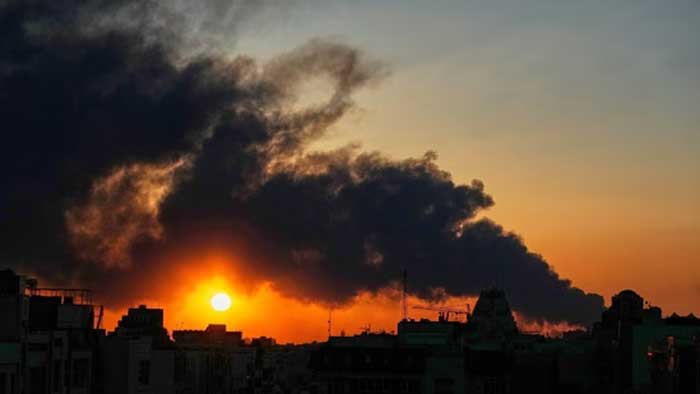
The escalating conflict between the United States, Israel and Iran has entered its seventh day, spreading across multiple countries in the Middle East and beyond.
What began with a joint US-Israel strike that killed Iran’s Supreme Leader Ayatollah Ali Khamenei has evolved into a rapidly expanding military confrontation involving missile attacks, air strikes, naval incidents and political divisions in Washington.
Israeli strikes have now reached Beirut’s southern suburbs, while Iranian retaliatory attacks have targeted American bases in several countries and Gulf states. Meanwhile, US forces say they have struck hundreds of targets deep inside Iran as part of a large-scale military campaign.
Conflict enters seventh day as Israeli strikes hit Beirut
The war entered its seventh day on Friday after Israeli forces announced a “next phase” of operations and carried out air strikes on the southern suburbs of Beirut, according to AFP.
The Israeli military had earlier issued an unprecedented evacuation warning for the entire area, urging residents to “save your lives and evacuate your residences immediately.” The alert triggered panic among civilians and mass evacuations from the suburbs.
Hezbollah drew Lebanon into the conflict earlier this week when the group launched attacks against Israel in retaliation for the killing of Ayatollah Ali Khamenei.
Israel responded with air strikes and deployed ground troops into some Lebanese border villages before expanding operations to Beirut’s southern suburbs on Thursday, targeting what it described as Hezbollah infrastructure.
The evacuation warnings led to severe traffic congestion as residents attempted to flee. AFP reported that some people fired guns into the air to urge others to leave the area quickly.
Hundreds of displaced families gathered on a Beirut beach after fleeing their homes, many unsure where to go.
Lebanese authorities said at least 123 people have been killed since Monday, with 683 injured and around 90,000 displaced.
Massive US air campaign targets Iranian missile infrastructure
The United States says it has launched one of its largest strike campaigns against Iranian military infrastructure in decades.
United States Central Command commander Brad Cooper said American forces have struck nearly 200 targets deep inside Iran in the past 72 hours.
“In just the last 72 hours, America’s bomber force has struck nearly 200 targets deep inside Iran,” Cooper said, adding that B-2 Spirit bombers dropped dozens of 2,000-lb bunker-buster bombs targeting deeply buried ballistic-missile launchers.
The operation, named Operation Epic Fury, is targeting Iran’s missile launchers, drone facilities and industrial infrastructure linked to the country’s ballistic-missile programme.
Cooper said the strikes have significantly reduced the intensity of Iran’s retaliatory attacks.
He added that ballistic-missile attacks had fallen by 90 per cent and drone attacks by 83 per cent, while more than 30 Iranian vessels had been destroyed.
“We’re not just hitting what they have, we’re destroying their ability to rebuild. We will systematically dismantle Iran’s missile production capability,” he said.
CENTCOM also revealed it has redeployed a captured Iranian drone design after reverse-engineering it in the US.
US defence chief warns Iran of prolonged war
US Secretary of Defense Pete Hegseth warned that Washington is prepared for a prolonged military campaign if required.
“Iran is hoping that we cannot sustain this, which is a really bad miscalculation for the Islamic Revolutionary Guard Corps,” he said.
“Our commitment to our mission objectives only increases as our advantages continue to increase. We have only just begun to fight and fight decisively,” he added.
Hegseth also dismissed concerns about a possible influx of refugees into the United States due to the conflict.
Israeli military kills senior Hezbollah commander
Israel also confirmed that it eliminated a senior Hezbollah commander in Beirut during the latest round of strikes.
The Israel Defense Forces said Zaid Ali Jumaa, Hezbollah’s head of artillery operations in southern Lebanon, was killed in the attack.
According to the Israeli military, Jumaa was responsible for launching thousands of rockets, missiles and drones toward Israeli territory.
The IDF said he had also been involved in a 2015 anti-tank missile attack in the Mount Dov area that killed two Israeli soldiers.
War spreads across Gulf region
The conflict has also affected several Gulf countries, with Iranian missiles and drones targeting cities and military facilities across the region.
In Kuwait, seven civilians including an 11-year-old girl were killed, while Bahrain said Iran had targeted two hotels and a residential building in the capital Manama, though there were no casualties.
Saudi Arabia said it intercepted three ballistic missiles aimed at an air base, while Qatar said it intercepted a missile over Doha.
Journalists reported loud explosions and thick black smoke rising over the city.
Meanwhile, falling debris from an intercepted drone injured six people in Abu Dhabi in the United Arab Emirates.
Naval incident near Sri Lanka raises tensions
The conflict has also extended beyond the Middle East following a major naval incident near Sri Lanka.
A US submarine sank the Iranian frigate IRIS Dena near the island nation earlier this week, according to Bloomberg.
The attack reportedly killed at least 84 Iranian sailors, while 32 crew members were rescued and more than 100 remain missing.
US Defence Secretary Pete Hegseth said the incident marked the first time since World War II that an American submarine had attacked a surface vessel.
Sri Lanka’s President Anura Kumara Dissanayake said authorities would take control of another Iranian vessel carrying about 200 crew members and move it to the northeastern port of Trincomalee due to rising regional tensions.
Authorities had earlier barred the ship from docking at Colombo because of insurance concerns linked to the conflict.
Anthony Albanese, the prime minister of Australia, confirmed that three Australian military personnel were aboard the US submarine during the attack, though they did not participate in the strike.
Azerbaijan warns retaliation after drone strike
On Iran’s northern border, Azerbaijan warned that a drone strike on an airport would “not go unanswered.”
Iran denied involvement and accused Israel of carrying out the attack, but Azerbaijani President Ilham Aliyev accused Tehran of “terrorism”.
Iran death toll rises as missile attacks continue
An Iranian state-run foundation said the death toll from US and Israeli strikes has risen to 1,230 people, though the figure could not be independently verified.
Iran’s Foreign Minister Abbas Araghchi said Tehran had no intention of negotiating with Washington.
“We do not see any reason why we should negotiate with the US,” Araghchi said, warning that any ground invasion would be disastrous for American forces.
US Congress divided over Trump’s war powers
Meanwhile, political divisions have emerged in Washington over President Donald Trump’s decision to launch strikes on Iran without congressional approval.
The United States House of Representatives narrowly rejected a war powers resolution seeking to halt the attacks, with the measure failing 212-219.
Gregory Meeks, the top Democrat on the House Foreign Affairs Committee, criticised the move, saying the president must seek approval from Congress before expanding the war.
However, House Speaker Mike Johnson defended the decision, arguing that the US was not formally at war and that the military operation remained limited in scope.
The vote revealed unusual cross-party alliances, with two Republicans backing the resolution alongside Democrats, while four Democrats sided with Republicans to defeat it.
Comments are closed, but trackbacks and pingbacks are open.