
US Defense Secretary Visits Korean DMZ Ahead of Talks on Future Role of American Troops

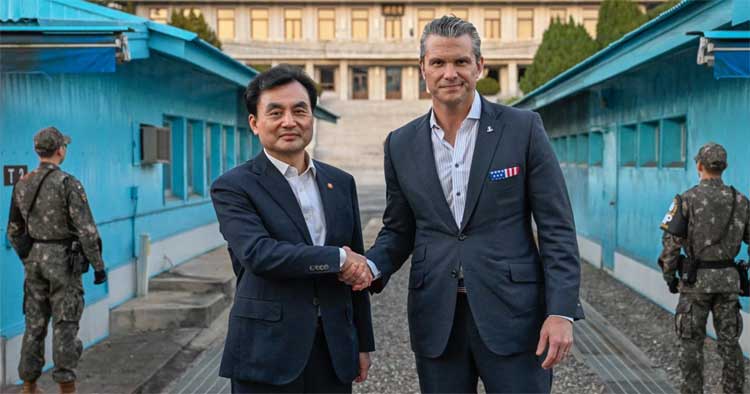
US Defense Secretary Pete Hegseth on Monday visited the Demilitarized Zone (DMZ) dividing the two Koreas, ahead of key talks that are expected to address Washington’s plans to redefine the role of US forces stationed in South Korea, Seoul’s defense ministry said.
Hegseth arrived at the border area by US Army helicopter and was received by South Korean Defense Minister Ahn Gyu-back. Calling the visit “symbolic and declarative,” Ahn said it underscored the strength of the South Korea-US alliance and their combined defense posture.
The visit comes a day before the annual Security Consultative Meeting, the highest-level defense dialogue between the two countries, where the allies will discuss deterrence against nuclear-armed North Korea, as well as cooperation on regional security, cyber defense and missile capabilities.
Washington is weighing a more “flexible” role for the 28,500 US troops in South Korea, potentially allowing them to operate beyond the Korean Peninsula in response to wider security challenges, including tensions over Taiwan and China’s growing military presence in the region. Seoul has pushed back against any shift away from a Korea-focused mission, even as it continues to expand its own defense capacity, now backed by a 450,000-strong military.
South Korea is planning its biggest defense budget hike in years for 2026, partly in response to US President Donald Trump’s renewed pressure on allies to increase their financial share of hosting American forces.
Hegseth also toured the Panmunjom truce village inside the DMZ alongside Ahn, as senior military officials from both countries met separately to review operational strategies. They agreed the regional security landscape was “complex and unstable,” South Korea’s Defense Ministry said, and pledged deeper coordination with allied partners across the Indo-Pacific.
North Korea, meanwhile, has rejected diplomatic overtures from both Trump and South Korean President Lee Jae-myung, while accelerating its missile programs and strengthening conventional forces.
Comments are closed.