
US, China Officials Meet in Kuala Lumpur to Avert Escalation in Trade War Ahead of Trump–Xi Talks

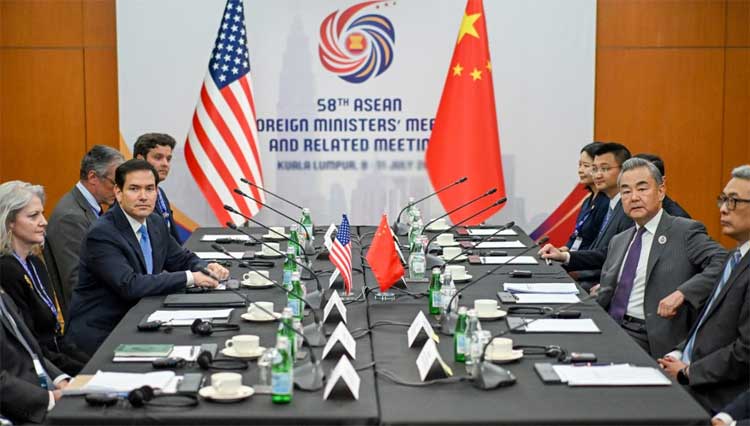
Top economic officials from the United States and China will meet in Kuala Lumpur on Saturday in a last-ditch effort to prevent an escalation of their trade war and secure a meeting next week between US President Donald Trump and Chinese President Xi Jinping.
The talks, held on the sidelines of the Association of Southeast Asian Nations (ASEAN) summit, come after Trump threatened to impose new 100% tariffs on Chinese goods starting November 1, in retaliation for Beijing’s sweeping export controls on rare earth magnets and minerals.
The recent tit-for-tat measures—including Washington’s expansion of its export blacklist to thousands more Chinese firms—have strained a fragile trade truce negotiated over four rounds of talks since May by US Treasury Secretary Scott Bessent, US Trade Representative Jamieson Greer, and Chinese Vice Premier He Lifeng.
On Saturday, the three will try to lay the groundwork for a Trump–Xi meeting next Thursday at the Asia-Pacific Economic Cooperation (APEC) summit in South Korea, where discussions could focus on temporary relief over tariffs, technology restrictions, and Chinese purchases of US soybeans.
Before that, however, He, Bessent, and Greer must first address the immediate flashpoints—China’s rare earth export curbs and US technology restrictions.
“The meeting can’t happen without an agreement to restore the interim ceasefire we had over the summer,” said Josh Lipsky, international economics chair at the Atlantic Council. “The US wants China to roll back its rare earth controls, but that’s Beijing’s main leverage.”
Few details have been shared about Saturday’s meeting, whose location was confirmed only after Chinese officials were seen arriving at the Merdeka 118 tower, the world’s second-tallest building. Trump is scheduled to arrive in Kuala Lumpur on Sunday.
“We won’t know if Beijing has successfully countered the US export controls—or simply triggered a new cycle of escalation—until Trump and Xi meet,” said Scott Kennedy, a China economics expert at the Center for Strategic and International Studies. “If they strike a deal, the gambit pays off. If not, things could turn much nastier.”
The world’s two largest economies are attempting to avoid a return to the triple-digit tariff levels seen in April, when Trump imposed sweeping global duties and China retaliated by halting rare earth shipments to US buyers.
Their first round of talks in Geneva in May led to a 90-day truce, reducing tariffs to about 55% on the US side and 30% on China’s while restoring magnet exports. The truce was extended in London and Stockholm but began to unravel in late September after Washington automatically added thousands of Chinese subsidiaries to its export blacklist.
China responded on October 10 by imposing new global export controls on rare earths, requiring licenses for any product using Chinese-origin rare earth materials or technology—an attempt to prevent their use in military systems.
Bessent and Greer slammed Beijing’s move as a “global supply chain power grab” and warned that the US and its allies would not accept such restrictions. According to Reuters, Washington is now considering new curbs on a wide range of software-based exports to China, including laptops and jet engines.
Adding further tension, the Trump administration on Friday launched a new investigation into China’s “apparent failure” to meet the terms of the 2020 “Phase One” trade deal, which had paused their earlier trade war. The probe could give Trump fresh legal grounds to raise tariffs.
China had pledged to boost imports of US farm goods, energy, manufactured products, and services under the 2020 pact, but targets were never fully met. The US may also pressure Beijing to resume soybean purchases after China bought none in September—an issue with major political implications for Trump’s rural base
Comments are closed.