
US and China Agree on Trade Talks Framework After Tensions

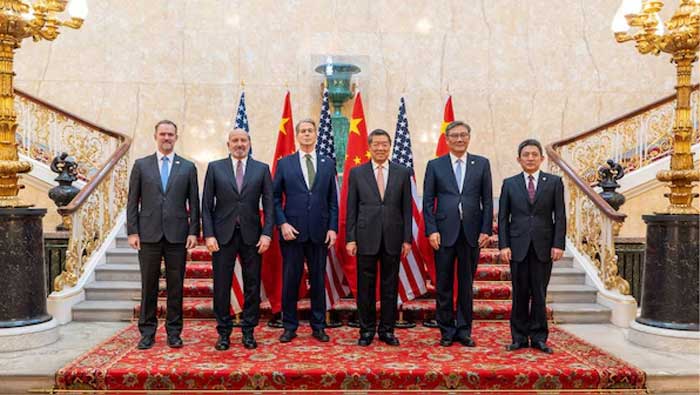
Senior U.S. and Chinese negotiators have reached a tentative framework to advance trade discussions, Chinese state media reported Wednesday, offering a possible path forward after recent disputes threatened to unravel progress made last month.
The agreement came after two days of high-level talks in London, which concluded late Tuesday. According to China’s official Xinhua News Agency, Vice Minister of Commerce Li Chenggang said both sides had agreed in principle on a framework to implement the consensus reached by Presidents Xi Jinping and Donald Trump during talks in Geneva.
The fragile truce from Geneva had been shaken by renewed tensions, prompting a phone call between the two leaders last week in an effort to restore calm.
The Chinese delegation in London, led by Vice Premier He Lifeng, included Commerce Minister Wang Wentao and Vice Minister Li. They met with U.S. Commerce Secretary Howard Lutnick, Treasury Secretary Scott Bessent, and Trade Representative Jamieson Greer at Lancaster House, a historic estate near Buckingham Palace.
No specific details were released about the framework or any upcoming negotiations.
Wendy Cutler, a former U.S. trade negotiator and now vice president at the Asia Society Policy Institute, noted that the delays have cost the two sides a third of the 90-day window they set in Geneva to resolve key issues.
“The U.S. and China lost valuable time in restoring their Geneva agreements,” Cutler said. “Now, only sixty days remain to address unfair trade practices, overcapacity, transshipment, and fentanyl.”
Since the Geneva meeting, tensions have flared over U.S. export restrictions on advanced semiconductors, visa access for Chinese students, and China’s export limits on rare earth minerals critical to industries like automotive manufacturing.
China, the world’s largest producer of rare earths, has hinted at easing restrictions imposed in April, which had rattled global supply chains. In return, Beijing wants the U.S. to lift curbs on semiconductor technology exports—a move Cutler said would mark a dramatic shift in U.S. policy.
“Negotiating on export controls is unprecedented,” she said. “It opens the door for China to push for their inclusion in future talks.”
President Trump emphasized the importance of market access in comments from the White House.
“We want to open up China,” he said. “If we don’t open up China, maybe we won’t do anything.”
Comments are closed.