
UNSG Urges Restraint Amid Thailand-Cambodia Border Clashes Displacing Thousands

United Nations Secretary-General António Guterres called for “utmost restraint” as violent clashes along the Thailand-Cambodia border escalated, displacing over 135,000 people and resulting in significant casualties. The conflict, centered around disputed territories near ancient temples, marks the deadliest confrontation between the two Southeast Asian nations in over a decade. This article explores the origins of the conflict, the humanitarian crisis, international responses, and the ongoing efforts to restore peace, drawing on recent statements and reports from the UN and other global entities.
Background of the Conflict
The Thailand-Cambodia border dispute, spanning a 508-mile (817 km) frontier, traces its roots to colonial-era maps drawn by France in 1907 during its occupation of Cambodia. The most contentious area surrounds the 11th-century Preah Vihear temple, a UNESCO World Heritage Site, and the nearby Ta Moan Thom temple, both claimed by both nations. A 1962 International Court of Justice (ICJ) ruling awarded Preah Vihear to Cambodia, reaffirmed in 2013, but ambiguities over surrounding territories have fueled intermittent clashes.
Tensions escalated in May 2025 after a Cambodian soldier was killed in a skirmish, followed by further incidents, including landmine explosions injuring Thai soldiers in July. The latest violence erupted on July 24, 2025, with both sides accusing each other of initiating gunfire near the Ta Moan Thom temple in Thailand’s Surin province and Cambodia’s Oddar Meanchey province. The conflict quickly spread to 12 locations, involving heavy artillery, rocket fire, and Thai airstrikes on Cambodian military targets.
Humanitarian Impact
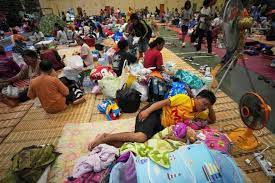
The clashes have caused significant loss of life and displacement. Thai authorities report 19 deaths, including 13 civilians and six soldiers, with 30 civilians and 29 soldiers injured. In Cambodia, at least 13 people, including eight civilians and five soldiers, have been killed, with five others wounded. Over 138,000 Thai civilians and 23,000 Cambodians, primarily from Preah Vihear and Oddar Meanchey provinces, have been evacuated to temporary shelters, including schools, temples, and sports complexes. Reports describe overcrowded shelters with urgent needs for food, water, and medical care.
UN humanitarian officials have confirmed civilian casualties, including children, prompting UNICEF to call for “maximum restraint” to protect children and critical services like schools, in line with the Convention on the Rights of the Child. Eyewitness accounts from evacuees, such as Pornpan Sooksai in Thailand, describe the terror of fleeing amid rocket and artillery fire, with some comparing the intensity to the Cambodian Civil War of the 1980s.
UN and International Response
UN Secretary-General António Guterres, through Deputy Spokesperson Farhan Haq, urged both nations to exercise restraint and resolve the dispute through dialogue, emphasizing “good neighbourliness” to achieve a lasting solution. On July 25, 2025, the UN Security Council held an emergency private meeting, briefed by Assistant Secretary-General Khaled Khiari, with representatives from Thailand and Cambodia in attendance. Council members urged de-escalation and diplomacy, though no formal resolution was adopted.
Global powers, including the United States, China, the European Union, Australia, Japan, and Russia, have echoed calls for an immediate ceasefire and peaceful resolution. The U.S., a treaty ally of Thailand, expressed “grave concern” over civilian harm, while China, with close ties to both nations, attributed the conflict to colonial legacies and offered to mediate. Malaysian Prime Minister Anwar Ibrahim, chair of ASEAN, proposed a ceasefire, which Cambodia initially supported but Thailand conditioned on “appropriate on-the-ground conditions.”
Cambodia has accused Thailand of using cluster munitions, a claim Thailand denies, though it acknowledges considering their use against military targets, noting it is not bound by the Convention on Cluster Munitions. These allegations have raised concerns about violations of international law, with Cambodia labeling Thai actions as “war crimes.”
Political Dynamics and Leadership Tensions
The conflict is complicated by domestic political dynamics. In Cambodia, Prime Minister Hun Manet, who succeeded his father Hun Sen in 2023, faces pressure to assert authority amid his father’s lingering influence. Hun Sen’s public feud with Thaksin Shinawatra, father of Thailand’s suspended Prime Minister Paetongtarn Shinawatra, has exacerbated tensions. A leaked phone call in June 2025, where Paetongtarn appeared deferential to Hun Sen, led to her suspension and public outrage in Thailand, weakening her government. Acting Thai Prime Minister Phumtham Wechayachai has warned that the conflict “could develop into war,” rejecting mediation offers from the U.S. and China while expressing openness to ASEAN-led talks.
Historical Context and Challenges
The border dispute has flared periodically since 2008, when Cambodia’s attempt to register Preah Vihear as a UNESCO site sparked protests from Thailand. A 2011 clash killed 20 people and displaced thousands, and the current violence is the most severe since then. Cambodia’s recent appeal to the ICJ in June 2025 was rebuffed by Thailand, which rejects the court’s jurisdiction. ASEAN’s non-interference policy limits its mediation capacity, leaving China as a potential broker, though its alignment with Cambodia raises concerns in Bangkok.
Current Sentiment and Future Outlook
Posts on X reflect global concern, with users like @UN_News_Centre and @KhmerTimes highlighting the UN’s call for restraint and the plight of displaced civilians, including children. @IntelWarRoom noted the Security Council’s emergency meeting, while @stiwari1510 and @meshygrey reported Thailand’s rejection of U.S. and Chinese mediation, underscoring fears of escalation.
The UN and its partners stand ready to provide humanitarian support, but both nations must commit to a ceasefire for aid to reach affected communities effectively. Without diplomatic progress, the risk of further escalation remains high, threatening regional stability and the lives of thousands more.
The Thailand-Cambodia border clashes represent a dangerous escalation of a century-old dispute, with significant humanitarian and geopolitical consequences. UN Secretary-General António Guterres’ call for restraint, backed by global leaders, underscores the urgency of de-escalation through dialogue. As over 135,000 people remain displaced and casualties mount, the international community, including ASEAN and major powers, must work to facilitate a ceasefire and address the root causes of the conflict. The situation remains fluid, with diplomacy offering the best path to prevent a broader war and alleviate the suffering of affected communities.
Comments are closed.