
UN Summit to Center on Gaza, Palestinian Future

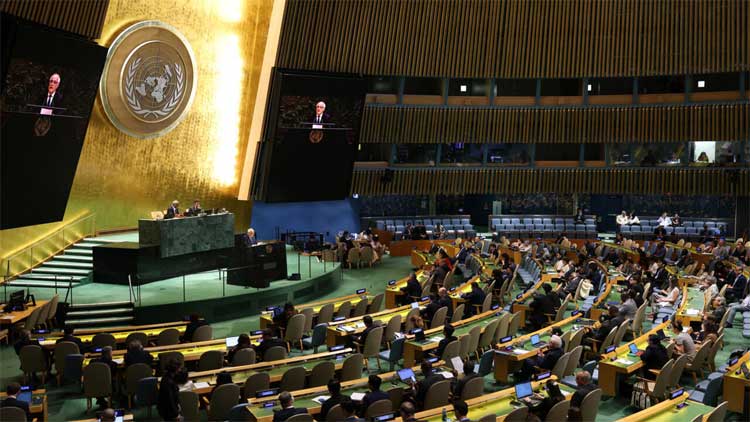
More than 140 world leaders are set to gather in New York next week for the United Nations General Assembly (UNGA), with debates expected to be dominated by the future of Palestine and the war in Gaza.
Conspicuously absent will be Palestinian President Mahmud Abbas, after Washington denied visas to him and his delegation. Two years into Israel’s Gaza offensive—sparked by the Hamas attack of October 7, 2023—the humanitarian disaster in the enclave is at the forefront of the global agenda.
The summit opens Monday with Saudi Arabia and France co-chairing talks on reviving the two-state solution. Their push comes days after the UN General Assembly overwhelmingly backed a resolution supporting Palestinian statehood—excluding Hamas. France is among the countries expected to formally recognize Palestine at the meeting.
International Crisis Group analyst Richard Gowan called the move “symbolic” but noted it could gain weight if countries follow through with pressure on Israel to halt its campaign. He also warned of potential reprisals by Israeli Prime Minister Benjamin Netanyahu, who will address UNGA and has repeatedly vowed that no Palestinian state will be established under his leadership.
The US, Israel’s staunchest ally, opposes recognition and has barred Abbas’s delegation from entry. Instead, the Assembly will vote Friday on allowing Abbas to address the gathering via video link. His remarks will be closely watched in Washington, particularly by President Donald Trump, who has slashed US foreign aid and UN funding since returning to office.
UN Under Strain
The 80-year-old UN marks the summit amid financial crises and wars that have raised doubts about its effectiveness.
“The multilateral system is under existential threat,” warned Federico Borello, interim head of Human Rights Watch, pointing to violations in Gaza, Ukraine, and elsewhere. UN Secretary-General Antonio Guterres urged leaders to respond with “actions that match the gravity of the challenges,” citing Gaza, Ukraine, Sudan, and climate change as urgent priorities.
New Leaders and Familiar Flashpoints
Among the notable first-time attendees is Syria’s new president, Ahmed Al-Sharaa, less than a year after ousting Bashar Assad. His government now faces the monumental task of postwar reconstruction.
Also attending are Ukrainian President Volodymyr Zelensky, Brazil’s Luiz Inácio Lula da Silva, and Iranian President Masoud Pezeshkian. Iran’s nuclear program is expected to be another flashpoint, with sanctions—lifted a decade ago—potentially returning at the end of September after being re-triggered by Paris, London, and Berlin.
On Wednesday, Guterres and Lula will convene a climate summit where some states may announce new emission-cut targets, setting the stage for COP30 in Brazil later this year.
Comments are closed.