
UN Security Council Backs US Gaza Plan, Authorizes International Stabilization Force

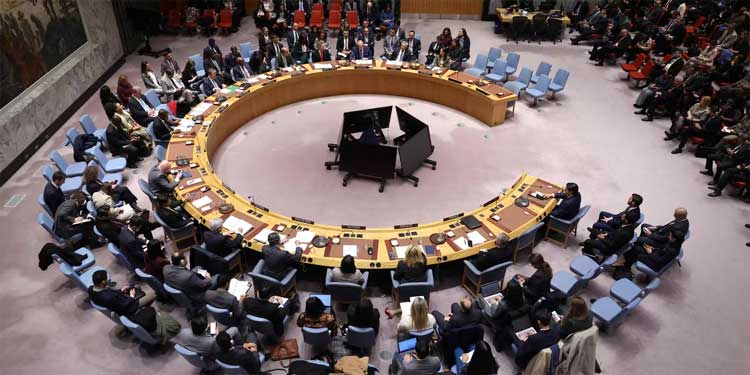
The UN Security Council on Monday approved a US-drafted resolution setting out a postwar framework for Gaza, including the creation of an international stabilization force and a potential political path toward an independent Palestinian state. The measure passed with 13 votes in favor and two abstentions from Russia and China, both of which chose not to veto the plan despite circulating an alternative proposal.
The resolution marks a critical step for the fragile ceasefire and for shaping Gaza’s future after two years of war between Israel and Hamas. Several Arab and Muslim nations — which had indicated willingness to contribute troops to an international force — had emphasized that Security Council authorization was essential before they could participate.
At the heart of the text is the endorsement of President Donald Trump’s 20-point ceasefire plan, which calls for the creation of a Board of Peace, a transitional authority Trump would chair. The resolution grants the stabilization force a broad mandate: overseeing border security, demilitarizing Gaza, and helping establish order. Authorization for both the board and the force expires at the end of 2027.
US Ambassador Mike Waltz hailed the vote as “historic and constructive,” saying it sets Gaza on a new trajectory. “Today’s resolution represents another significant step toward a stable Gaza … and an environment that will allow Israel to live in security,” he said, while stressing that the effort is “just the beginning.”
Revised language on Palestinian statehood helped secure support
During nearly two weeks of negotiations, Arab states and Palestinian representatives pushed Washington to strengthen language on Palestinian statehood. The final text says that once reforms are enacted within the Palestinian Authority and reconstruction advances in Gaza, “conditions may finally be in place for a credible pathway to Palestinian self-determination and statehood.”
It further commits the United States to establishing a dialogue between Israel and the Palestinians to define a “political horizon” for peaceful coexistence.
The inclusion of statehood language triggered criticism from Israeli Prime Minister Benjamin Netanyahu, who has vowed to oppose any process leading to a Palestinian state, arguing it would reward Hamas and jeopardize Israel’s security.
Key to the resolution’s passage was backing from Arab and Muslim countries advocating a ceasefire and exploring participation in the stabilization mission. On Friday, the US mission to the UN released a joint statement with Qatar, Egypt, the UAE, Saudi Arabia, Indonesia, Pakistan, Jordan, and Turkiye urging swift adoption of the American proposal.
Russia floated a competing plan
The vote came amid efforts to preserve the fragile ceasefire following the war triggered by Hamas’ Oct. 7, 2023, attack on southern Israel, which killed about 1,200 people. Israel’s two-year military campaign in Gaza has killed more than 69,000 Palestinians, according to Gaza health officials, who say most victims are women and children but do not differentiate between civilians and fighters.
Last week, Russia introduced its own rival draft, calling for clearer, stronger support for Palestinian statehood and insisting that the West Bank and Gaza be unified under the Palestinian Authority. Moscow’s proposal removed references to the transitional Board of Peace and asked UN Secretary-General António Guterres to present separate options for a security force and implementation of the ceasefire.
What the US-backed plan authorizes
The resolution empowers the stabilization force to ensure the demilitarization of Gaza, including the “permanent decommissioning” of weapons held by non-state armed groups — a major challenge given Hamas’ stance on disarmament.
The force is authorized to use “all necessary measures” to carry out its mission, UN language permitting the use of military force. Its responsibilities include securing Gaza’s borders in coordination with a vetted Palestinian police force and facilitating humanitarian aid deliveries. The mission is instructed to work closely with Egypt and Israel.
As the force establishes control and stability, Israeli troops will withdraw from Gaza under a system of benchmarks and timelines tied to the demilitarization process. These conditions must be agreed upon by the stabilization force, Israeli forces, the United States, and the guarantors of the ceasefire.
Comments are closed.