
UN Investigator Navi Pillay Sees Rwanda Parallels in Gaza, Hopes Israeli Leaders Face Justice

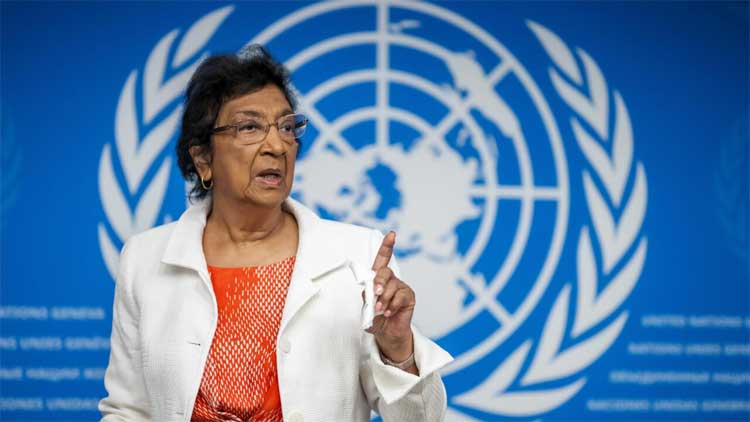
The UN investigator who accused Israel this week of committing genocide in Gaza says she sees echoes of Rwanda’s 1994 butchery and hopes Israeli leaders will one day be brought to trial.
Navi Pillay, a South African former judge who headed the International Criminal Tribunal for Rwanda and later served as UN human rights chief, acknowledged that justice “is a slow process.” But, she added, quoting Nelson Mandela: “It always seems impossible until it’s done.”
Pillay’s Independent International Commission of Inquiry (COI), which does not speak on behalf of the UN, issued a report on Tuesday declaring that “genocide is occurring in Gaza” — a charge Israel strongly rejects. The report accused President Isaac Herzog, Prime Minister Benjamin Netanyahu, and former defense minister Yoav Gallant of “inciting the commission of genocide.” Israel slammed the findings as “distorted and false.”
For Pillay, the parallels with Rwanda — where 800,000 Tutsis and moderate Hutus were slaughtered — are striking. As tribunal head, she was scarred for life by footage of killings and torture. “I see similarities to what is happening in Gaza,” she said, pointing to “the same kind of methods.”
In Rwanda, Tutsis were labelled “cockroaches.” In Gaza, she noted, Palestinians have been called “animals” by Israeli officials — rhetoric she said dehumanizes entire groups and signals that “it’s ok to kill them.”
The International Criminal Court has already issued arrest warrants for Netanyahu and Gallant over alleged war crimes, though Pillay admitted enforcement is difficult: “The ICC does not have its own sheriff or police force.” Still, she said, history shows popular pressure can drive change, recalling how apartheid ended in her own lifetime despite seeming impossible.
Now 83, Pillay has spent decades tackling difficult cases — from defending anti-apartheid activists to presiding at the Rwanda tribunal, serving at the ICC, and leading the UN’s human rights office from 2008 to 2014. She took on the Gaza inquiry four years ago, weathering accusations of bias and antisemitism, as well as calls in the U.S. for sanctions against her and her colleagues.
But the hardest part, she said, has been watching hours of graphic evidence: “Watching those videos is just traumatic,” she said, citing images of sexual violence against women and doctors stripped naked by soldiers. “It’s so painful.”
The commission now plans to draft a list of suspected perpetrators in Gaza and examine the “complicity” of countries backing Israel. That work, however, will fall to her successor — Pillay is stepping down in November for age and health reasons.
Before leaving, she intends to present the report to the UN General Assembly in New York. “I have my visa ready,” she said. “So far, I have heard nothing about it being withdrawn.”
Comments are closed.