
UK and Germany Sign Landmark Treaty to Deepen Defense and Security Ties Amid Russian Threat

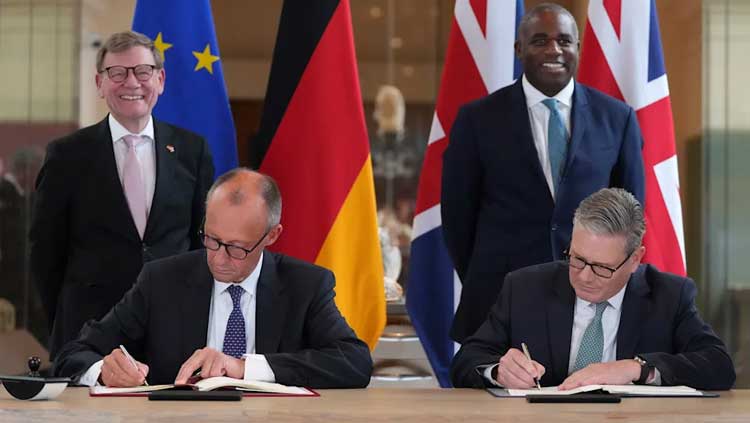
British Prime Minister Keir Starmer and German Chancellor Friedrich Merz signed a landmark treaty in London on Thursday, pledging closer defense and security cooperation as Europe braces for continued Russian aggression and uncertain support from the United States under President Donald Trump’s “America First” approach.
Calling it “a historic day for German-British relations,” Merz said the agreement, which also covers investment and law enforcement cooperation, marks a significant step forward in bilateral ties — particularly in the post-Brexit era. “It is overdue for us to conclude such a treaty with each other,” he added.
Reinforcing a Strategic Alliance
The treaty builds on a bilateral defense pact signed last year, reaffirming the UK and Germany’s shared commitment to supporting Ukraine and strengthening European security. While both countries are NATO members and already bound by Article 5 — the alliance’s mutual defense clause — the new agreement includes a pledge to assist each other militarily in the event of an armed attack.
“We see the scale of the challenges our continent faces today, and we intend to meet them head-on,” Starmer said during a joint press conference at an Airbus defense facility near London. He described the treaty, signed at the V&A Museum, as a “partnership with a purpose.”
The agreement also echoes last week’s Anglo-French commitments made during President Emmanuel Macron’s state visit to the UK, including coordination on nuclear deterrence — a first for Britain and France. While Germany has no nuclear arsenal, the treaty with London promises continued dialogue on nuclear and other defense matters of “mutual interest.”
Both countries reiterated their pledge to raise defense spending to 3.5% of GDP in response to pressure from Washington, where Trump has pushed NATO allies to shoulder more of the military burden.
Joint Support for Ukraine and Arms Cooperation
Merz and Starmer discussed ways to strengthen European military support for Ukraine. This includes a new plan — floated by the Trump administration — for NATO countries to purchase U.S. weapons and then transfer them to Kyiv. Merz acknowledged the plan is still under discussion and that “it might take days, perhaps weeks” before implementation begins. He emphasized the need for assurances on how European-supplied weapons will be replenished by the U.S.
The leaders also unveiled new defense industry initiatives, including a German drone manufacturer, Stark, opening a production facility in the UK to supply Ukraine. The two countries will also co-produce defense systems such as Boxer armored vehicles and Typhoon jets and plan to develop a precision long-range missile within the next decade.
Tackling Migration and Organized Crime
The treaty expands cooperation on law enforcement, with a focus on curbing human smuggling networks that operate across the English Channel. In 2024, over 37,000 people crossed the Channel in small boats from France, with more than 22,000 making the journey so far this year. Dozens have died attempting the dangerous trip.
Merz confirmed that Germany would adopt new legislation by year’s end making it a criminal offense to facilitate migrant smuggling into the UK — a move Starmer hailed as “hugely welcome.”
Rebuilding Post-Brexit Bridges
While Starmer has ruled out rejoining the EU’s single market or customs union, he has prioritized repairing relationships with European neighbors after years of Brexit-induced strain. The new UK-Germany agreement also includes a cultural component: easing student exchange travel between the two countries.
“I am glad we were able to reach an agreement so that schoolchildren and students can come to Britain more easily in the future — and likewise, to Germany,” Merz said. “The young generation should have the opportunity to get to know both countries better.”
This was Merz’s first official visit to the UK since taking office in May. He noted that it was no coincidence it came just a week after Macron’s visit, underscoring growing alignment between Europe’s major powers.
“The E3 — Great Britain, France, and Germany — are converging in their positions on foreign policy, on security, on migration, and also on economic matters,” Merz said.
Comments are closed.