
U.S. Defense Department Establishes Guidelines for Possible Use of Force by Marines Deployed to LA Protests

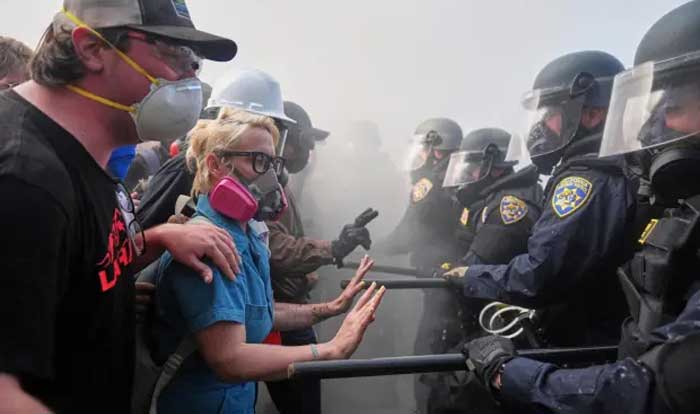
The U.S. Department of Defense was in damage control mode on Monday, working to finalize rules for Marines potentially facing the difficult and unusual challenge of using force against American citizens. This comes after the Trump administration ordered active-duty troops to Los Angeles to assist with the immigration raid protests.
U.S. Northern Command announced that 700 Marines from the 2nd Battalion, 7th Marines, based in Twentynine Palms, California, will be deployed to Los Angeles to protect federal personnel and property, including federal immigration agents. They will augment the 4,100 National Guard members already stationed in the area or authorized for deployment.
These Marines have received training in de-escalation tactics, crowd control, and standing rules for using force. However, the decision to send active-duty troops into a domestic, protest-driven scenario still raises significant legal and ethical questions.
The Marines are highly trained for combat and crisis situations, with previous experience in conflict zones like Syria and Afghanistan. But the situation they could soon face is very different. For example, protesters might throw gas canisters, and the Marines could be forced to decide whether to defend themselves or protect federal agents from crowds.
According to a U.S. official, the troops will be armed with their standard service weapons but will not carry tear gas. They will also have protective gear, including helmets, shields, and gas masks.
Overseas, military forces operate under specific rules of engagement. At home, however, they are governed by “standing rules for the use of force,” which are being formulated by Northern Command. Marines will receive a card explaining the limits of their actions. For instance, the use of warning shots will be prohibited, and de-escalation will be prioritized. However, troops are authorized to act in self-defense if necessary.
The Pentagon is also preparing a memo with more detailed guidance for the Marines, outlining steps they can take to protect federal personnel and property. These guidelines could include the temporary detention of civilians in specific circumstances, such as when troops are under threat or to prevent harm, with the goal of transferring them to law enforcement authorities later.
Deploying the Marines for this mission avoids invoking the Insurrection Act, a law that would give the president the power to use federal troops in law enforcement roles during national emergencies. The Insurrection Act has rarely been used; the last significant instance was in 1992, when President George H.W. Bush deployed troops to restore order during the Los Angeles riots following the acquittal of the officers involved in the Rodney King beating.
However, if the situation escalates and violence intensifies, questions remain about what legal authority the Marines would have to engage in crowd control or policing. Elizabeth Goitein, a senior director at the Brennan Center for Justice, raised concerns, pointing out that if Marines are forced to physically engage with civilians, it could raise serious legal issues. “No statutory authority that Trump has invoked so far permits this,” Goitein said.
The idea of deploying the Marines to address unrest was first suggested by Defense Secretary Pete Hegseth, who tweeted about it after discussing the situation with General Dan Caine, Chairman of the Joint Chiefs of Staff. Hegseth’s tweet, however, caught many at the Pentagon off guard, as it was sent from his personal Twitter account, not his official government one.
As of Monday, military leaders were still assessing the potential ramifications. There was also an internal debate within the Marine Corps about whether to deploy more senior, experienced personnel to minimize the risks of putting less experienced Marines in situations where they might have to make tough decisions about using force against civilians.
The legal framework for any domestic deployment is shaped by the Fourth Amendment, which prohibits unreasonable seizures of persons, including temporary detainment, unless it’s deemed justified by the situation. Additionally, the Posse Comitatus Act generally prohibits military personnel from engaging in law enforcement activities on U.S. soil, creating yet another layer of complexity.
As the Pentagon finalizes its rules, the implications of deploying active-duty Marines in a domestic protest situation are becoming increasingly difficult to ignore.
Comments are closed.