
Trump’s Military Parade Overshadowed by Protests, Violence, and Global Tensions
President Donald Trump’s long-envisioned military parade rolled through the streets of downtown Washington on Saturday to mark the 250th anniversary of the U.S. Army. But the celebratory display was marred by nationwide unrest, violent incidents, and deepening global tensions.
The event, which coincided with Trump’s 79th birthday, unfolded amid a volatile backdrop. Hours before the first tanks rolled down Constitution Avenue, hundreds of thousands of Americans took to the streets in cities across the country—New York, Chicago, Los Angeles, and beyond—in the largest wave of anti-Trump protests since his return to office in January.
Adding to the day’s turmoil, a Democratic lawmaker was assassinated and another wounded in a shooting in Minnesota. The gunman remains at large.
Meanwhile, overseas, Israel launched a second wave of airstrikes on Iran in an aggressive bid to dismantle Tehran’s nuclear infrastructure. The escalation, coming just a day after Iran retaliated with its own missile attack, stoked fears of a widening regional war.
Back home, tensions remained high in Los Angeles, where week-long protests over federal immigration raids had prompted Trump to deploy National Guard troops and U.S. Marines—despite opposition from California Governor Gavin Newsom.
A Parade in a Time of Discord
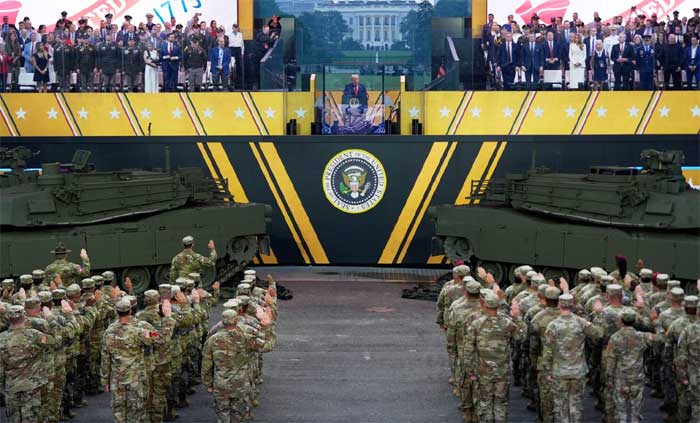
Despite looming thunderstorms, the parade began earlier than scheduled, with tanks, artillery, and armored vehicles thundering down Constitution Avenue—a rare sight in the U.S., where large-scale military parades are uncommon.
“Every other country celebrates their victories—it’s about time America did too,” Trump declared to a crowd of supporters, watching from behind bulletproof glass.
Around 7,000 troops and 150 military vehicles, including M1 Abrams tanks, Stryker armored vehicles, and M777 howitzers, were mobilized for the event. Cabinet officials including Defense Secretary Pete Hegseth and Secretary of State Marco Rubio were in attendance.
Trump has championed the idea of a grand military parade since early in his first term. The last major show of this kind in Washington occurred in 1991, celebrating victory in the Gulf War. This year’s festivities are expected to cost between $25 million and $45 million, including logistics, equipment transport, and troop accommodations—prompting criticism over government spending.
Critics have called the display an authoritarian show of power. But Trump supporters like Bryan Henrie, who flew in from Texas, defended it: “I don’t see a controversy. I will celebrate safety and stability any day over anarchy,” he said.
Protesters Nationwide Reject Trump’s Agenda
Despite the military fanfare, the day was defined as much by the opposition as by the celebration. Peaceful protests erupted nationwide under the banner “No Kings,” emphasizing that no individual—Trump included—is above the law.
In Washington, demonstrators lined streets near the parade route. While some held protest signs within view of the procession, others were corralled into separate zones by police.
About 400 people gathered across from the White House, organized by RefuseFascism.org. “Today we refuse to accept Donald Trump unleashing the military against the people of this country,” said activist Sunsara Taylor. “We say, ‘hell no.’”
In Los Angeles, police used tear gas and flash-bang grenades to disperse crowds near the federal building, now heavily guarded by Marines. Protesters shouted “Shame! Shame!” and “Marines, get out of L.A.!”
Actor Mark Ruffalo joined demonstrators in New York’s Bryant Park wearing a hat that read “immigrant.” Signs played off the “No Kings” slogan—one read, “No crown for a clown.”
In Chicago, protesters waved upside-down American flags and chanted, “No justice, no peace.” In Atlanta, members of the far-right Proud Boys confronted “No Kings” demonstrators while wearing the group’s signature black-and-yellow colors.
Cooper Smith, a 20-year-old protester from upstate New York, summed up the day’s sentiment: “We’re seeing dehumanizing language toward LGBT people, people with autism, disabilities, racial minorities, undocumented people. Somebody’s got to show that most Americans are against this.”
Trump, for his part, had warned that demonstrators who disrupted the parade would be “met with very big force.” But the protests, though widespread and impassioned, remained largely peaceful.
Comments are closed.