
Trump’s Grip Tightens: Congress Cedes Ground as GOP Aligns Behind the President

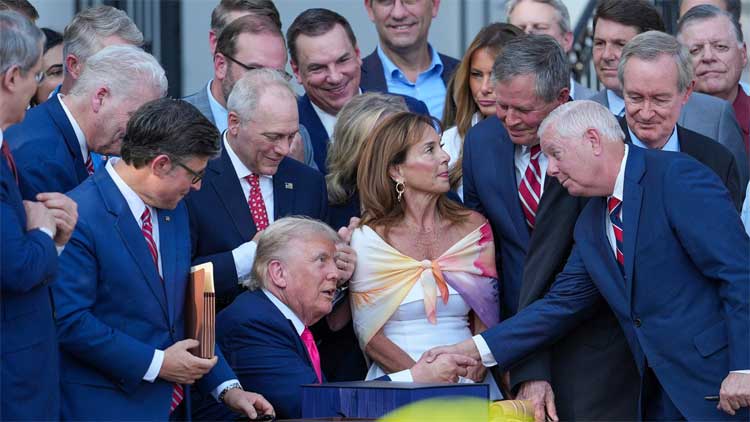
At a symbolic Fourth of July signing ceremony, House Speaker Mike Johnson handed President Donald Trump the gavel used to pass a sweeping legislative package.
“Mr. President, this is the gavel used to enact the ‘big, beautiful bill.’ I want you to have it,” Johnson said.
Seated behind a desk on the White House lawn, Trump gave the gavel a few approving thumps—sealing more than just a legislative milestone.
The gesture, while ceremonial, marked something deeper: a visible shift in power from Capitol Hill to the White House. With Republicans firmly backing Trump’s agenda, the legislative branch appears increasingly willing to defer to the executive, even at the expense of its own authority.
A Compliant Congress
Since Trump’s return to the White House in January, Republican lawmakers have rapidly aligned behind him, pushing through his legislative priorities with little resistance.
-
A major tax-and-spending package was fast-tracked to meet Trump’s Independence Day deadline.
-
Cabinet nominees like Robert F. Kennedy Jr. (Health Secretary) and Pete Hegseth (Defense Secretary) were confirmed despite bipartisan concerns.
-
The House launched investigations into political adversaries, including probing President Biden’s use of the autopen.
-
Congress also paused sanctions against Russia, following Trump’s unilateral move to give Vladimir Putin 50 additional days to negotiate peace in Ukraine.
Even more striking was Congress’s recent decision to revoke $9 billion in previously approved funding—a rare move that challenged the legislature’s constitutional control over federal spending.
Strains Within the GOP
Not all Republicans are on board. Some are growing uneasy with how much control the White House now exercises over Congress.
“We’re lawmakers. We should be legislating,” said Sen. Lisa Murkowski (R-Alaska), objecting to Trump’s push to strip funding from public broadcasting and overseas aid.
“We’re getting directives from the White House, being told, ‘This is the priority. Execute it.’ I don’t accept that.”
Sen. Susan Collins (R-Maine) and Sen. Thom Tillis (R-N.C.) both defied Trump on key bills. Tillis, facing intense pressure, has since announced he will not seek reelection in 2026.
Meanwhile, Rep. Thomas Massie (R-Ky.) has proposed releasing the long-classified Jeffrey Epstein files, challenging Trump on an issue the president had been reluctant to confront.
A New Generation of Trump-Aligned Republicans
Unlike during Trump’s first term—when figures like Liz Cheney and Mitt Romney publicly pushed back—today’s GOP is more Trump-aligned than ever. Many of the new generation of Republicans owe their rise to the MAGA movement and have adopted Trump’s combative style.
Speaker Mike Johnson and Senate Majority Leader John Thune have both drawn closer to Trump. Johnson has even described Trump as essential to keeping Congress “on track.” When a recent cryptocurrency bill hit a roadblock, Trump hosted dissenting lawmakers in the Oval Office, with Johnson joining in by phone.
“I want a normal Congress,” Johnson has said. Yet he continues to rely heavily on the White House to resolve internal disputes.
The Shrinking Power of Congress
Critics warn that the growing deference to the executive is eroding the Constitution’s separation of powers.
“The genius of our Constitution is the separation of power,” said former Speaker Nancy Pelosi, in a radio interview.
“That Republicans have melted the power of the speakership and Senate leadership to cater to the executive branch is deeply troubling.”
With Congress increasingly passive, the judiciary has become the primary check on presidential power, handling hundreds of lawsuits challenging the administration’s actions.
“Nowhere in the Constitution does it say that if the president wants something, you must do it,” said Sen. Brian Schatz (D-Hawaii) on the Senate floor.
“We don’t have to operate under the assumption that this man is uniquely so powerful.”
As Trump’s influence grows, the U.S. finds itself at a familiar but more intensified crossroads—a presidency emboldened, and a Congress that seems content to follow its lead.
Comments are closed.