
Trump Unveils $92 Billion in Energy and Infrastructure Deals to Power AI Growth

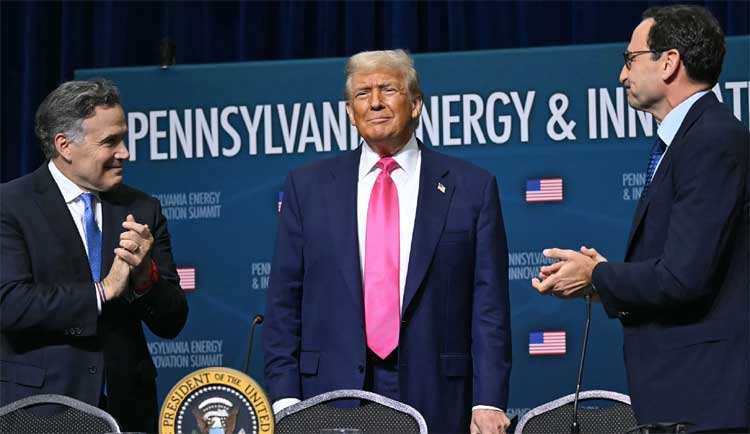
President Donald Trump on Tuesday announced $92 billion in energy and infrastructure investments aimed at meeting the surging electricity demands of the artificial intelligence (AI) sector. The announcement came during the inaugural Pennsylvania Energy and Innovation Summit at Carnegie Mellon University, where Trump framed the initiative as critical to maintaining U.S. leadership in the global AI race.
“Today’s commitments are ensuring that the future is going to be designed, built, and made right here in Pennsylvania, right here in Pittsburgh — and I have to say, right here in the United States of America,” Trump declared.
As generative AI becomes central to the next wave of technology, concerns have mounted about whether the nation’s current power grid can support the massive energy consumption required, especially from data centers relying on power-hungry processors like those produced by Nvidia — now the world’s most valuable company by market capitalization.
Government officials estimate that by 2028, the AI industry will demand up to five gigawatts of electricity — enough to power approximately five million homes.
Big Tech and Energy Giants Join Forces
Executives from leading companies including Palantir, Anthropic, ExxonMobil, and Chevron attended the summit. The funding package will support the construction of data centers, energy generation facilities, grid infrastructure improvements, AI training programs, and skilled labor apprenticeships.
As part of the plan, Google pledged $25 billion to build AI-ready data centers across Pennsylvania and neighboring states. Google also announced a partnership with Brookfield Asset Management to modernize two of Pennsylvania’s hydropower facilities, contributing 670 megawatts to the regional grid.
“We support President Trump’s clear and urgent direction that our nation invest in AI so that America can continue to lead,” said Google President and CFO Ruth Porat.
Investment firm Blackstone also committed over $25 billion to expand data center capacity and energy infrastructure nationwide.
A Strategic Play Against China
US Senator David McCormick of Pennsylvania emphasized the national implications of the initiative: “These investments are of enormous consequence to Pennsylvania, but they are also crucial to the future of the nation.”
The announcement reflects growing bipartisan concern in Washington over China’s advances in AI. Trump echoed those sentiments, stating, “We are way ahead of China, and the plants are starting up, the construction is starting up.”
The initiative builds on Trump’s earlier launch of the “Stargate” project in January — a $500 billion push to develop AI infrastructure across the United States. The initial $100 billion phase is backed by SoftBank, OpenAI, and Oracle.
Policy Shifts and What’s Next
Trump has also reversed several Biden-era regulations that restricted AI algorithm development and limited exports of advanced technology to certain allied nations. These moves are intended to accelerate domestic innovation and attract foreign investment.
He is expected to release a detailed national strategy on AI later this month.
President Donald Trump on Tuesday announced $92 billion in energy and infrastructure investments aimed at meeting the surging electricity demands of the artificial intelligence (AI) sector. The announcement came during the inaugural Pennsylvania Energy and Innovation Summit at Carnegie Mellon University, where Trump framed the initiative as critical to maintaining U.S. leadership in the global AI race.
“Today’s commitments are ensuring that the future is going to be designed, built, and made right here in Pennsylvania, right here in Pittsburgh — and I have to say, right here in the United States of America,” Trump declared.
As generative AI becomes central to the next wave of technology, concerns have mounted about whether the nation’s current power grid can support the massive energy consumption required, especially from data centers relying on power-hungry processors like those produced by Nvidia — now the world’s most valuable company by market capitalization.
Government officials estimate that by 2028, the AI industry will demand up to five gigawatts of electricity — enough to power approximately five million homes.
Big Tech and Energy Giants Join Forces
Executives from leading companies including Palantir, Anthropic, ExxonMobil, and Chevron attended the summit. The funding package will support the construction of data centers, energy generation facilities, grid infrastructure improvements, AI training programs, and skilled labor apprenticeships.
As part of the plan, Google pledged $25 billion to build AI-ready data centers across Pennsylvania and neighboring states. Google also announced a partnership with Brookfield Asset Management to modernize two of Pennsylvania’s hydropower facilities, contributing 670 megawatts to the regional grid.
“We support President Trump’s clear and urgent direction that our nation invest in AI so that America can continue to lead,” said Google President and CFO Ruth Porat.
Investment firm Blackstone also committed over $25 billion to expand data center capacity and energy infrastructure nationwide.
A Strategic Play Against China
US Senator David McCormick of Pennsylvania emphasized the national implications of the initiative: “These investments are of enormous consequence to Pennsylvania, but they are also crucial to the future of the nation.”
The announcement reflects growing bipartisan concern in Washington over China’s advances in AI. Trump echoed those sentiments, stating, “We are way ahead of China, and the plants are starting up, the construction is starting up.”
The initiative builds on Trump’s earlier launch of the “Stargate” project in January — a $500 billion push to develop AI infrastructure across the United States. The initial $100 billion phase is backed by SoftBank, OpenAI, and Oracle.
Policy Shifts and What’s Next
Trump has also reversed several Biden-era regulations that restricted AI algorithm development and limited exports of advanced technology to certain allied nations. These moves are intended to accelerate domestic innovation and attract foreign investment.
He is expected to release a detailed national strategy on AI later this month.
Comments are closed.