
Trump threatens to escalate Iran war, but says it could end soon.

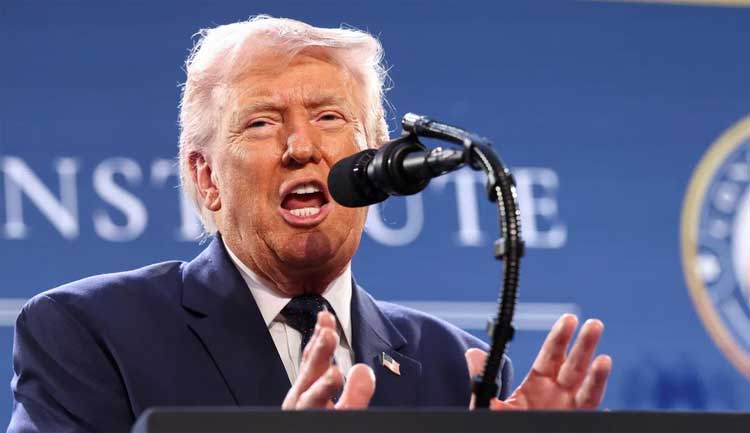
US President Donald Trump on Monday warned that the United States could escalate its war with Iran if Tehran attempted to block oil shipments from the Middle East, even as he predicted the conflict would end sooner than expected.
Trump’s warning came after a turbulent day in global markets, which swung sharply amid concerns that Iran’s security establishment was consolidating behind newly declared Supreme Leader Mojtaba Khamenei and was unlikely to back down soon.
Speaking at a news conference, Trump said US forces had inflicted major damage on Iran’s air force and navy. He also predicted the war would end well before the initial four-week timeframe he had suggested earlier, though he did not clearly define what victory would entail.
The US president cautioned that American strikes could intensify dramatically if Iran tried to disrupt tanker traffic through the Strait of Hormuz — a strategic passage that carries roughly one-fifth of the world’s oil supply.
“We will hit them so hard that it will not be possible for them or anybody else helping them to ever recover that section of the world,” Trump said.
Iran says it will decide when war ends
In response, Iran’s powerful Islamic Revolutionary Guard Corps said it would not allow “one litre of oil” to leave the region if US and Israeli attacks continued.
“We are the ones who will determine the end of the war,” a spokesperson said, according to Iranian state media.
The conflicting signals rattled financial markets. Oil prices surged while stock markets fell sharply before partially recovering after Trump suggested the war might end quickly and hinted at possible easing of sanctions on Russian energy.
Khamenei, a 56-year-old Shiite cleric with deep support among Iran’s security forces and their vast business networks, has been rejected by Trump, who has demanded Iran’s unconditional surrender.
State media in Iran showed large crowds rallying behind the new leader in several cities, waving national flags and holding portraits of his father, Ali Khamenei — the longtime supreme leader who was killed in an Israeli strike on the first day of the war.
In the historic Imam Square in Isfahan, state television reported the sound of nearby explosions during apparent airstrikes as supporters gathered, chanting “God is the Greatest” beneath images of Ali and Mojtaba Khamenei.
Iranians contacted by phone appeared divided. Supporters of the government praised the leadership transition, while critics feared it would crush hopes for political change.
“It was a slap in the face to our enemies who thought the system would collapse after the killing of his father. Our late leader’s path will continue,” said Tehran university student Zahra Mirbagheri, 21.
Others expressed despair at the prospect of the system remaining firmly in control. “The Guards and the system are still powerful. They have tens of thousands ready to fight to keep this regime in place. We, the people, have nothing,” said Babak, a businessman in the central city of Arak.
Israel says its objective is to topple Iran’s clerical system, while US officials have mostly framed Washington’s goal as destroying Iran’s missile and nuclear capabilities. Trump, however, has suggested the war can only end with a compliant Iranian government.
Oil surges amid Strait of Hormuz disruption
The conflict has effectively halted shipping through the Strait of Hormuz — a critical route for global oil and liquefied natural gas — leaving tankers stranded for more than a week and forcing producers to curb pumping as storage facilities fill.
Global benchmark Brent crude surged about 7% to its highest closing level since 2022 after rising as much as 29% during the trading session, partly as OPEC members including Saudi Arabia cut supplies. Prices later slipped in post-settlement trade.
Rising fuel costs carry major political implications in the United States ahead of the November midterm elections, where Republicans hope to retain control of Congress.
After speaking with Russian President Vladimir Putin, Trump said Washington could waive oil-related sanctions on “some countries” to ease supply shortages — a move that could potentially include further easing restrictions on Russian oil, complicating efforts to pressure Moscow over the war in Ukraine.
Oil refinery hit as war widens
Meanwhile, black smoke blanketed parts of Tehran after an oil refinery was struck in an apparent escalation targeting Iran’s domestic energy infrastructure.
Tedros Adhanom Ghebreyesus, head of the World Health Organization, warned the fire could contaminate food, water and air supplies.
Turkiye said its NATO air defenses intercepted a ballistic missile fired from Iran that briefly entered Turkish airspace — the second such incident since the war began.
Israel’s military said it launched fresh strikes in central Iran and also hit targets in Beirut after the Iran-backed militia Hezbollah fired across the border.
According to Iran’s UN ambassador, US-Israeli strikes have killed at least 1,332 Iranian civilians and wounded thousands. In Lebanon, authorities say more than 400 people have been killed and nearly 700,000 displaced.
In Israel, emergency services reported that one man died from shrapnel injuries at a construction site near Ben Gurion Airport, bringing the death toll from Iranian attacks to 11.
Comments are closed, but trackbacks and pingbacks are open.