
Trump Signs Bill Ending Longest Government Shutdown in US History

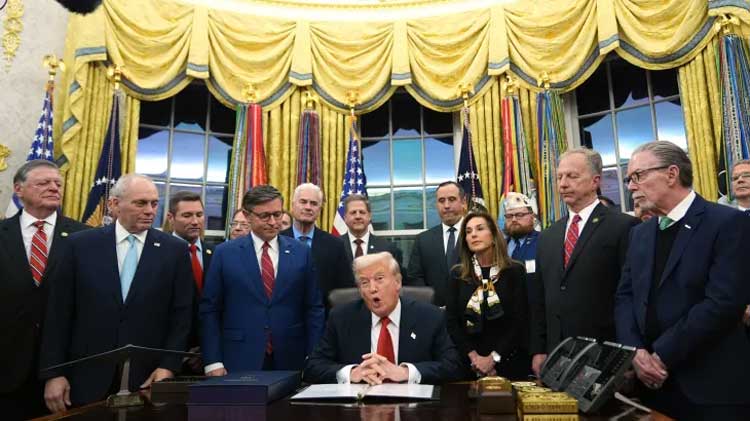
President Donald Trump on Wednesday signed a funding package to end the longest government shutdown in American history, just hours after the House of Representatives voted to restart stalled programs, restore federal worker pay, and revive key government operations.
The Republican-controlled House passed the bill 222–209, largely along party lines, with Trump’s backing helping keep his caucus united despite fierce opposition from Democrats. The legislation, which cleared the Senate earlier in the week, will reopen the government after a 43-day shutdown — the longest ever — and fund operations through January 30.
The move will send hundreds of thousands of furloughed federal employees back to work as early as Thursday, though the timeline for a full restoration of services remains uncertain. The short-term funding measure will also add roughly $1.8 trillion annually to the federal debt, which now stands at around $38 trillion.
“I feel like I just lived a Seinfeld episode. We just spent 40 days and I still don’t know what the plotline was,” quipped Rep. David Schweikert (R-Ariz.), criticizing Congress for the protracted standoff. “What’s happened now when rage is policy?”
The shutdown’s end offers relief to air travelers and federal employees alike, especially with the busy Thanksgiving season approaching. It will also restore food assistance to millions of low-income families and restart the flow of critical economic data that had been halted, leaving policymakers and markets in the dark. However, the White House said reports on October employment and inflation may never be released.
Economists estimate the shutdown reduced GDP growth by more than a tenth of a percentage point for each week it lasted, though most of the lost output is expected to be regained in the months ahead.
Healthcare Dispute Remains Unresolved
The vote followed a string of Democratic election victories that had buoyed hopes for extending expiring federal health insurance subsidies. While the Senate deal allows for a vote on the subsidies in December, House Speaker Mike Johnson has made no such commitment.
In her final address to Congress before resigning to become New Jersey’s next governor, Rep. Mikie Sherrill (D-N.J.) urged lawmakers to resist what she called Trump’s heavy-handed tactics.
“To my colleagues: Do not let this body become a ceremonial red stamp for an administration that takes food away from children and rips away health care,” she said. “To the country: Stand strong. As we say in the Navy — don’t give up the ship.”
No Clear Political Winner
A Reuters/Ipsos poll released Wednesday found Americans almost evenly divided on blame for the shutdown — 50% faulting Republicans and 47% Democrats — suggesting no clear political victor from the six-week impasse.
The House’s return from a long recess not only paved the way for the shutdown’s end but also reignited debate over unrelated controversies. Newly sworn-in Democrat Adelita Grijalva of Arizona provided the final signature for a petition forcing a House vote on releasing unclassified files related to the late financier Jeffrey Epstein, a move opposed by Trump and Speaker Johnson.
The funding bill also includes a provision allowing eight Republican senators to sue the Justice Department for up to $500,000 each over alleged privacy violations during the investigation of the January 6, 2021, Capitol riot. The measure makes it illegal, in most cases, to obtain a senator’s phone records without disclosure and permits those affected to recover damages and legal fees.
With the shutdown over, Congress now faces another looming deadline in just over two months — and little sign that the deep partisan divides that fueled the crisis have eased.
Comments are closed.