
Trump faces Republican backlash over Iran war as administration seeks $70 billion funding

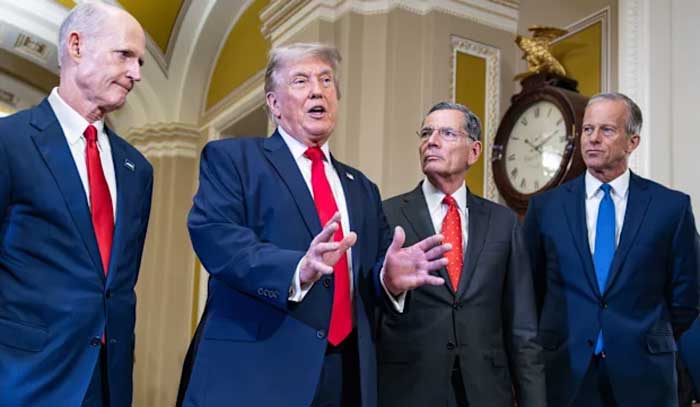
US President Donald Trump faced sharp criticism from members of his own Republican Party over the Iran war during a closed-door meeting on Wednesday, shortly before his administration asked Congress for tens of billions of dollars to fund the conflict.
Several Republican lawmakers said Trump had a heated exchange with Senator Bill Cassidy, who questioned the administration’s explanation of a framework deal signed last week that offers financial incentives to Iran but, according to critics, falls short of the objectives Trump outlined when the war began.
“The American people need to know more than we are being told,” Cassidy told reporters, saying it was unclear whether the war was progressing as the administration had initially promised.
The confrontation highlighted growing political pressure on Trump ahead of November’s elections, which will decide control of Congress. A Reuters/Ipsos poll found that only one in four Americans believes the war was worth its costs, while Trump’s approval rating has fallen to its lowest level since he returned to office last year.
The clash came a day after the Senate passed a resolution calling on Trump to end the war, a largely symbolic move backed by four Republicans, including Cassidy, along with opposition Democrats.
Trump later dismissed the Senate vote as meaningless, saying Iran would question why such a move had taken place.
Hours afterward, the administration requested $70 billion from Congress to cover war expenses, adding to the already massive US defence budget.
Cassidy later thanked Vice President JD Vance and Special Envoy Steve Witkoff for briefing him at the White House and said the meeting addressed several of his concerns.
Oil prices drop as tensions ease
The preliminary US-Iran agreement has helped reopen traffic through the Strait of Hormuz, a key global energy route that previously handled a significant share of oil and liquefied natural gas shipments.
Oil prices fell on Wednesday to their lowest level since before the war began as concerns over supply disruptions eased. However, disagreements remain over several parts of the agreement, including financial support for Iran, nuclear inspections, control of the strait and Israel’s ongoing conflict in Lebanon.
The deal begins a 60-day negotiation period focused on resolving more complicated issues, including Iran’s nuclear programme.
Middle East allies question agreement
The proposed peace deal has also faced scepticism from several Middle Eastern countries, particularly US Gulf allies that believe the agreement may be too favourable to Tehran.
Critics have raised concerns over a proposed $300 billion reconstruction fund and the lifting of some sanctions, warning that the money could help Iran rebuild its military capabilities. The agreement also does not address Iran’s ballistic missile programme.
The deal requires Iran to keep shipping routes open through the Strait of Hormuz for 60 days, though Tehran has suggested it may seek to introduce fees afterward.
US Secretary of State Marco Rubio said Washington would not support measures that threaten the security of American allies in the region.
Israel and Lebanon discuss US-backed proposal
Meanwhile, Israel and Lebanon held talks in Washington over a US-backed proposal involving the withdrawal of Israeli forces from some areas captured during the conflict and their transfer to Lebanese army control.
Israeli Prime Minister Benjamin Netanyahu said Israel would not withdraw troops from the region.
The situation remains tense as Israel continues fighting Hezbollah in Lebanon, which entered the conflict in support of Iran. An Israeli drone strike on a vehicle in southern Lebanon killed at least two people on Wednesday, according to Lebanese sources, while Israel said it had targeted two armed Hezbollah fighters.
Comments are closed.