
Trump Deploys Nuclear Submarines After Medvedev’s Doomsday Threat, Escalating US-Russia Tensions

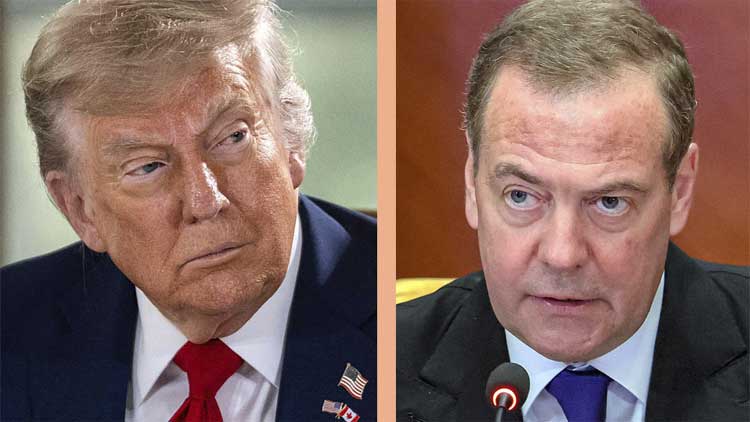
In a sharp escalation of tensions between the United States and Russia, former US President Donald Trump on Friday announced he had ordered the deployment of two nuclear submarines in response to what he described as “highly provocative” statements by Russian official Dmitry Medvedev.
The announcement, made via Trump’s Truth Social account, marks a dramatic shift from verbal sparring to visible military posturing, raising fears of heightened nuclear brinkmanship between the two powers amid the ongoing war in Ukraine.
“I have ordered two Nuclear Submarines to be positioned in the appropriate regions, just in case these foolish and inflammatory statements are more than just that,” Trump posted.
“Words are very important, and can often lead to unintended consequences. I hope this will not be one of those instances.”
While it is rare for US leaders to publicly comment on nuclear submarine movements — operations usually cloaked in secrecy — Trump’s disclosure adds urgency and gravity to what began as a war of words.
What Triggered Trump’s Response?
Trump’s decision appears to be a direct response to recent comments by Dmitry Medvedev, Russia’s former president and current deputy chairman of its Security Council. On Thursday, Medvedev posted on Telegram invoking the “Dead Hand” — a Cold War-era automated nuclear retaliation system — a veiled warning of Russia’s apocalyptic capabilities.
Medvedev’s post followed Trump’s earlier remarks branding Russia’s and India’s economies as “dead.” In a series of posts and interviews, the two figures have traded barbs that have taken a dark nuclear tone.
In a subsequent interview, Trump said:
“When you mention the word ‘nuclear’… my eyes light up. We better be careful — it’s the ultimate threat. So I have sent two nuclear submarines closer to Russia to ensure that his words remain just words.”
Trump did not clarify whether the submarines were nuclear-powered or nuclear-armed, nor did he specify their locations — information typically classified by the US military.
Medvedev’s Provocations and Role
Medvedev’s role in Russia’s current power structure is largely ceremonial, but his social media rhetoric often toes — or even amplifies — the Kremlin’s most aggressive lines.
On Monday, he warned that Trump should “remember the formidable potential of our country.” By Thursday, his language escalated with the reference to “Dead Hand,” widely interpreted as a threat of automatic nuclear retaliation.
Trump fired back, calling him a “failed former president of Russia who thinks he’s still president,” and accused him of “entering very dangerous territory.”
Putin’s Missile Reveal and Ukraine Context
The Trump-Medvedev exchange coincided with significant Russian military announcements. President Vladimir Putin revealed that Russia had begun mass production of its Oreshnik hypersonic missile — capable of carrying nuclear warheads — and that deployment in Belarus could happen by year-end.
Standing with Belarusian President Alexander Lukashenko, Putin said:
“Most likely, we will close this issue by the end of the year.”
Putin also repeated his long-standing conditions to end the Ukraine war: Kyiv must renounce NATO membership and cede disputed territories. The demand remains a non-starter for both Ukraine and its Western allies.
Hours before Trump’s submarine order, Russia launched missile and drone strikes on Kyiv, killing 31 civilians — including five children — and prompting a day of mourning in the Ukrainian capital. Ukrainian President Volodymyr Zelensky renewed his call for direct talks with Putin and urged Russia to accept US mediation.
What This Means for Global Security
The United States and Russia together control over 90% of the world’s nuclear arsenal. The US maintains a nuclear triad — bombers, land-based missiles, and submarines — with at least one nuclear-armed submarine on constant patrol.
Trump’s public acknowledgment of submarine movement could be interpreted as a strategic warning or a diplomatic provocation, depending on how Moscow reads it. Analysts warn that escalating rhetoric and military gestures heighten the risk of miscalculation.
For now, the world watches anxiously as two of the most powerful nuclear actors exchange threats — no longer just with words, but with weapons in motion.
Comments are closed.