
Trump claimed China, India ‘unfairly’ tariff US, questioned trade data in tense White House meeting: book

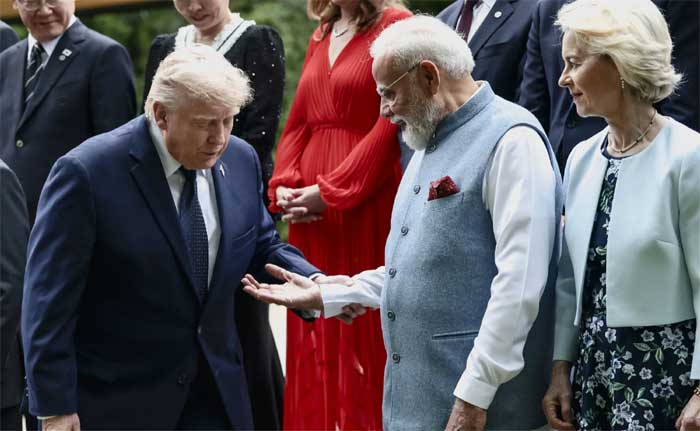
US President Donald Trump reportedly accused China and India of imposing unfairly high tariffs on American goods during a meeting with Commerce Secretary Howard Lutnick, Tesla CEO Elon Musk and other technology leaders, according to a newly published book.
The meeting, held on March 10, 2025, focused on boosting semiconductor manufacturing in the United States and reducing dependence on overseas supply chains. Trump was reportedly frustrated by Taiwan’s dominance in the chip industry, which accounts for a major share of global semiconductor production, including advanced chips.
The details were revealed in “Regime Change: Inside the Imperial Presidency of Donald Trump”, written by New York Times journalists Maggie Haberman and Jonathan Swan.
The meeting included executives from major technology companies such as IBM, Dell, HPE, HP, Qualcomm and Intel. During the discussion, Trump criticised the US for losing ground in semiconductor manufacturing.
“The US gave it all away,” Trump said, adding, “Ninety-nine percent of the business is in Taiwan.”
Musk, who was leading the now-defunct Department of Government Efficiency (DOGE) at the time, warned about the risks of relying on Taiwan for advanced chip production.
“Chip fab capacity in the US is weak. Especially for the most advanced chips. The United States will only have thirty percent of TSMC’s capacity in 2029. If China invades Taiwan, the entire economy crashes,” Musk said, according to the book.
Trump later questioned why Taiwan remained ahead in the semiconductor sector and urged companies to expand manufacturing in the US, saying firms building domestically would face fewer risks and tariffs.
He warned that companies refusing to invest in the US could face steep tariffs, claiming Washington was being treated unfairly by trading partners.
“Those who won’t build here are going to have massive tariffs to pay… not 20 percent, like 100 percent. We’re treated so unfairly. China tariffs us over 150 to 200 percent, India 175 percent,” Trump said.
Trump’s clash with Lutnick over India tariff figures
The book also describes another heated discussion on March 26, 2025, between Trump and members of his economic team over tariff calculations.
Trump reportedly demanded what he called the “real” tariff numbers imposed by other countries, expressing frustration that he had not been given accurate data.
When Lutnick presented figures from the US Trade Representative’s office, Trump reportedly rejected them and accused officials of providing incorrect information.
The disagreement came shortly before Trump announced his “Liberation Day” tariff measures, under which India faced a 25% tariff. Later, tariffs on Indian imports were increased to 50% over concerns related to purchases of Russian oil.
Earlier, India and the US had agreed on a framework for a bilateral trade agreement, with Washington agreeing to reduce tariffs on Indian goods to 18% from 25%.
However, after the US Supreme Court struck down parts of Trump’s tariff policy and Washington introduced temporary tariff measures, both countries revisited parts of the proposed agreement.
India and the US are now aiming to finalise the trade pact before July 24, when previous tariff arrangements are expected to come under review.
Comments are closed.