
Trump and Putin Trade ‘Paper Tiger’ Jabs in Echo of Mao-Era Propaganda

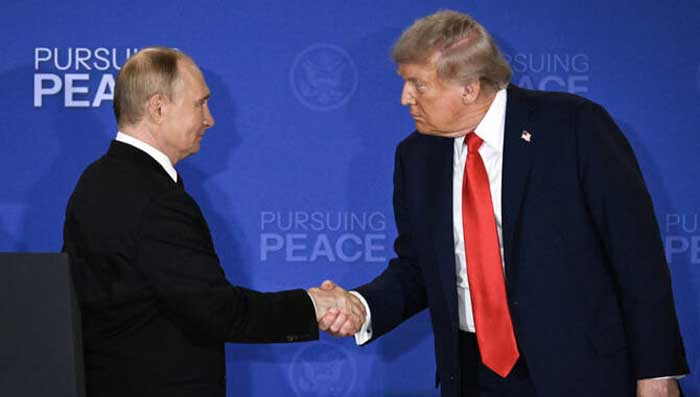
Nearly eight decades after Mao Zedong famously labeled the United States a “paper tiger” to rally his people, U.S. President Donald Trump and Russian President Vladimir Putin are trading the same insult over the war in Ukraine.
In a Sept. 23 post on Truth Social, Trump mocked Russia’s military, calling it “a paper tiger.” The Kremlin quickly pushed back. While Trump briefly softened his tone, he revived the jab days later while addressing U.S. military leaders, saying of Russia’s prolonged invasion, “You’re four years fighting a war that should have taken a week. Are you a paper tiger?”
Putin fired back on Thursday: “We are fighting against the entire NATO bloc, and we keep advancing. And we are a paper tiger? What is NATO then?” He added, “A paper tiger? Go and deal with this paper tiger, then.”
The exchange amused historians familiar with Mao’s original use of the phrase. “As a Chinese historian, I had to laugh at the irony when President Trump appropriated one of Chairman Mao’s favorite expressions,” said John Delury, a senior fellow at the Asia Society. “Mao said it about the U.S. when America had a growing nuclear arsenal and China had none. Now U.S. and Russian leaders are calling each other ‘paper tigers’ while Xi Jinping looks like the adult in the room.”
The Chinese term zhilaohu — literally “paper tiger” — has deep roots in Communist Party propaganda. Mao used it in a 1946 interview with American journalist Anna Louise Strong, calling the U.S. atomic bomb a “paper tiger” meant to scare people. The metaphor, which describes something that appears powerful but is weak in reality, became a cornerstone of Maoist rhetoric.
During the Cold War, it was wielded as a “sharp thought weapon” against Western powers, especially the U.S. Though the phrase faded as U.S.-China relations improved in the 1970s, it has reappeared in recent years amid renewed tensions.
In 2024, a Chinese foreign ministry spokesperson quoted Mao on social media during a trade dispute, saying, “America is just a paper tiger. Don’t believe its bluff. One poke, and it’ll burst.”
Before Trump’s recent use of the term, American commentators had already borrowed it. In February, Washington Post columnist Eugene Robinson described Trump’s foreign policy as that “of a paper tiger,” while Harvard professor Laurence Tribe used the same phrase in May to downplay Trump’s threats toward foreign students.
What began as Mao’s revolutionary taunt has now resurfaced as a symbol of political bravado — one that continues to echo from Beijing to Washington to Moscow.
Comments are closed.