Trump Administration Signs First ‘America First’ Global Health Deal With Kenya as USAID Shutdown Reverberates Across Africa

The Trump administration has signed the first of what officials say will be dozens of new “America First” global health agreements, designed to channel U.S. funding to countries aligned with the president’s broader foreign-policy priorities.
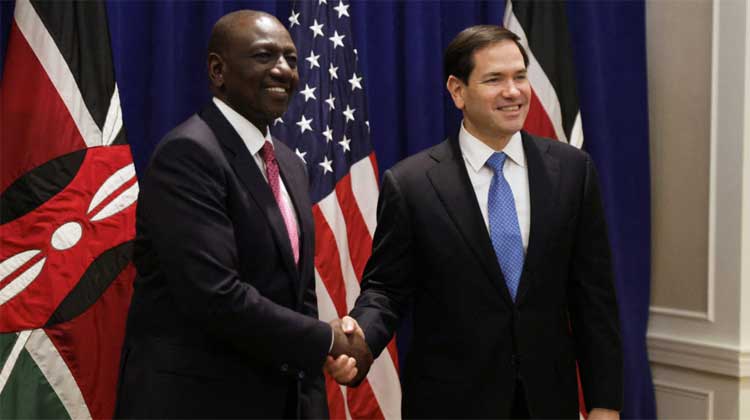
The inaugural deal — a five-year, $2.5 billion health partnership with Kenya — was signed Thursday by Kenyan President William Ruto and U.S. Secretary of State Marco Rubio. It replaces a longstanding network of health agreements previously administered by the U.S. Agency for International Development (USAID), which the administration dismantled earlier this year.
The elimination of USAID as a standalone agency triggered widespread alarm among global health experts after hundreds of programs across the developing world lost funding, including initiatives supporting maternal and child care, nutrition, and HIV/AIDS prevention.
Rubio said the new agreement with Kenya “aims to strengthen U.S. leadership and excellence in global health while eliminating dependency, ideology, inefficiency, and waste” from the foreign aid system. He also praised Kenya’s leadership in the multinational stabilization force in Haiti.
Ruto welcomed the pact and said Kenya would continue participating in Haiti as the anti-gang mission transitions to a broader operation.
Deal Details
Under the Kenya agreement, the U.S. will provide $1.7 billion, while Kenya will contribute $850 million. The focus areas include preventing and treating HIV/AIDS, malaria and tuberculosis. The framework places particular emphasis on faith-based medical providers, though all facilities enrolled in Kenya’s national health insurance program will qualify for support.
“This cooperation framework is quite a departure from the past and will have a lasting impact on health for all,” said Ouma Oluga, Kenya’s principal secretary for medical services.
Family-planning programs that comply with U.S. abortion-related restrictions will also remain eligible. Negotiators Jeremy Lewin and Brad Smith said the pact would not discriminate against LGBTQ+ communities or sex workers.
U.S. officials expect several other African countries to sign similar agreements by year’s end. But two of the continent’s largest nations — Nigeria and South Africa — are unlikely to join soon due to political differences with Trump, the negotiators said.
Lewin noted that talks with Nigeria continue despite “very significant concerns the president has around the persecution of Christians.” A finalized agreement, he said, would ideally “enhance” efforts to address those concerns.
Impact of USAID Shutdown Ripples Across Africa
The dismantling of USAID disrupted programs combating hunger, disease, maternal mortality, extremism and democratic backsliding, and left thousands of health workers unemployed after U.S. funding for their salaries disappeared.
Sub-Saharan Africa’s HIV response has been particularly hard hit. The closure of USAID severely affected the President’s Emergency Plan for AIDS Relief (PEPFAR), the landmark bipartisan initiative launched under George W. Bush that is credited with saving 25 million lives worldwide.
South Africa — home to the world’s largest population of people living with HIV — previously relied on USAID and PEPFAR for more than $400 million annually to fund antiretroviral treatment for over 5 million patients. Until recently, U.S. contributions made up nearly 20% of South Africa’s entire HIV budget. Trump-era cuts and freezes slashed that support.
In July, UNAIDS warned that as many as 4 million people could die globally if PEPFAR funding was not restored.
Facing mounting criticism, the administration reinstated limited assistance, including a $115 million grant to help sustain South Africa’s HIV program through at least March. However, Trump has since vowed to halt all aid to the country over his widely disputed claims of violent persecution of the Afrikaner white minority.
Nigeria, another nation heavily burdened by HIV/AIDS, has also been targeted by Trump’s accusations of discrimination against Christians. The country received nearly $4 billion in U.S. health funding between 2020 and 2025 — support that helped stabilize a chronically underfunded system in a nation of nearly 220 million people.
With only 4–5% of Nigeria’s federal budget allocated to health, the sudden withdrawal of American support has deepened an already severe crisis, collapsing programs that millions relied on for basic medical care.
Comments are closed.