

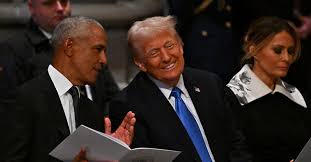
President Donald Trump escalated his attacks on former President Barack Obama, accusing him and other former officials of committing “treason” by allegedly orchestrating a conspiracy to undermine Trump during the 2016 election. These claims came during mounting pressure over Trump’s handling of the Jeffrey Epstein case and renewed scrutiny from within his political base.
What Trump Said
Speaking from the Oval Office, Trump referred to recently declassified intelligence documents released by his Director of National Intelligence, Tulsi Gabbard, which he claimed exposed a “treasonous conspiracy” by the Obama-era leadership. He labeled Obama as the “leader of the gang,” asserting:
-
“They tried to steal the election, they tried to obfuscate the election… This was treason, this was every word you can think of.”
-
He called for criminal prosecution of Obama and other high-level officials, including James Comey, Hillary Clinton, and James Clapper.
Context: Epstein Controversy as Backdrop
Trump’s remarks came as he faced intense pressure over his response to the Epstein files and his refusal to fully release investigation materials related to Ghislaine Maxwell and Jeffrey Epstein. Facing demands from his MAGA supporters, he has pivoted to criticisms of former officials to deflect attention from the Epstein matter.
Obama’s Response
Barack Obama’s office issued a rare and strong rebuttal. A spokesperson condemned the allegations as “bizarre, ridiculous, and a weak attempt at distraction.” The statement clarified that prior intelligence findings and bipartisan Senate investigations consistently affirmed Russia’s interference in 2016, without evidence that votes were manipulated.
Political Fallout & Institutional Moves
-
A group of Republican senators, including Lindsey Graham and John Cornyn, called for the appointment of a special counsel to investigate Trump’s accusations—despite constitutional hurdles related to presidential immunity.
-
The Department of Justice has set up a “strike force” to evaluate alleged misconduct by Obama-era officials, following Tulsi Gabbard’s referral. Critics warn such a move dangerously politicizes national security.
Analysis: Evidence and Historical Context
-
Investigations by Special Counsel Robert Mueller and the Senate Intelligence Committee concluded that Russia sought to influence the 2016 election via disinformation, hacking of data, and online propaganda. No evidence was found supporting direct manipulation of vote counts or an orchestrated plot by Obama.
-
Analysts note that while some media pieces argue there were flaws in the original intelligence assessments, a criminal case for treason—which requires proof of levying war or giving aid to enemies—is constitutionally unlikely.
Supporter Reactions and Media Commentary
-
Trump’s MAGA base is divided, with some loyalists urging transparency over Epstein files and expressing frustration at continued deflection tactics.
-
On media panels, commentators criticized Trump’s language as inflammatory and unjustified, with heated debate over the irresponsibility of calling a former president a traitor without evidence.
-
Public voices argued the treason accusation reflects Trump’s long-standing fixation with Obama, aimed at diverting from substantive political issues.
Summary of Key Developments
| Topic | Detail |
|---|---|
| Trump’s Claim | Accused Obama and others of treason without new or credible evidence |
| Trigger | DOJ pressure over release of Epstein and Maxwell-related files |
| Obama’s Rebuttal | Called the allegations nonsensical and a diversion tactic |
| Senate & DOJ Reaction | Some Republicans requested special counsel; DOJ formed investigatory team |
| Evidence Review | Past bipartisan investigations found no collusion or criminal action |
| Political Landscape | Mixed reactions within Republican base and broader public criticism |
A Political Distraction or Justified Accountability?
Donald Trump’s explosive accusation of treason against Barack Obama reflects a broader strategy to deflect from current controversies, especially ongoing pressure over Epstein-related disclosures. While Tulsi Gabbard’s declassified statements are cited, they fall short of legal standards required to justify prosecution or prove conspiracy. Experts and former investigations overwhelmingly affirm Russia’s interference occurred—but not the existence of a deliberate, treasonous conspiracy led by Obama.
Comments are closed.