
Travelers Trapped, Flights Canceled as Iran-Israel Conflict Closes Airspace Across Region

After Israeli airstrikes landed near his hotel in Qom, Afghan businessman Aimal Hussein fled to Tehran in search of safety. But like tens of thousands across the Middle East, he found himself trapped. With Iranian airspace fully shut down and roads under threat, Hussein, 55, now sleeps in a hotel basement, unable to leave the country.
“Flights, markets—everything is closed,” Hussein told the Associated Press by phone on Monday. “I’m trying to get to the border by taxi, but they’re hard to find. No one is taking us.”
The strikes near Qom targeted a nuclear enrichment facility just 18 miles outside the city, part of Israel’s sweeping offensive since Friday that has killed senior Iranian military officials, nuclear scientists, and damaged key infrastructure. Iran has retaliated with hundreds of drones and missiles, plunging the region deeper into turmoil.
Airspace Closures Paralyze Travel Across Middle East
Most Middle Eastern countries have shut down their airspace in response to the escalating hostilities, leading to the grounding of flights, the closure of dozens of airports, and tens of thousands of stranded passengers. The ripple effect has overwhelmed airports and left many unsure when—or if—they’ll be able to travel home.
“This domino effect is massive,” said retired pilot and aviation safety expert John Cox. “You’ve got passengers, crews, and planes all in the wrong places. It’s going to be extremely costly.”
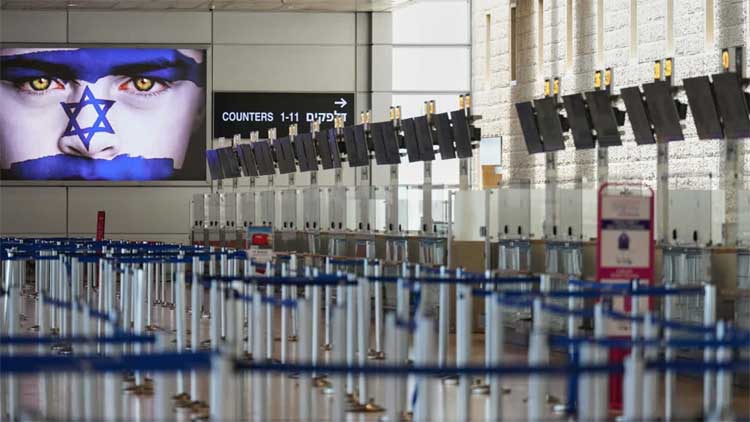
Israeli Prime Minister Benjamin Netanyahu’s office warned citizens against using border crossings with Jordan or Egypt, citing “high threat risks” despite diplomatic relations with both countries. Israel’s main international gateway, Ben Gurion Airport, has been closed “until further notice,” stranding over 50,000 Israelis abroad. Planes from Israel’s three national carriers have been diverted to Larnaca, Cyprus.
One such passenger, Zvika Berg, was en route to Israel from New York when his El Al flight was suddenly rerouted. “The pilot just said we were diverting to Larnaca,” said the 50-year-old. “Now I’m waiting in a hotel here, talking to my wife in Jerusalem, trying to figure out what to do.”
In Tel Aviv, Canadian traveler Mahala Finkleman was forced to shelter in a hotel bunker as Iranian drones struck the city overnight. “We hear the booms. Sometimes there’s shaking,” she said. “It’s actually scarier to see the footage afterward, knowing what happened right above our heads.”
Iran’s Airports Targeted, International Flights Grounded
Iran suspended all flights to and from Imam Khomeini International Airport near Tehran on Friday. Israel claims it struck Mehrabad Airport, which serves both the Iranian Air Force and domestic passengers, in an early assault.
In Syria, airports that were recently renovated after years of war have once again shut down. In Lebanon and Jordan, where airspace remains partially open, chaos reigns as flights are delayed, rerouted, or canceled entirely—despite the beginning of the busy summer tourism season.
Students Stranded in Iran and Iraq
Among the stranded are thousands of foreign students in Iran. Arsalan Ahmed, an Indian medical student in Tehran, described a grim reality: “It’s terrifying to watch on TV, but worse are the deafening explosions. We just stay in our hostels.”
While some Indian students have been moved to safer locations within Iran, the Indian government has yet to announce an evacuation plan.
In neighboring Iraq, all airports remain closed due to its proximity to Iran and its involvement in the conflict—Israeli strikes reportedly used Iraqi airspace, and Iranian drones have been intercepted overhead.
Some students have chosen to flee by land. Yahia Al-Suraifi, an Iraqi college student in Tabriz, said Israel’s strikes over the weekend destroyed the local airport and an oil facility. With the sky lit up by drones and missiles, he and dozens of fellow students paid drivers to take them 200 miles overnight to the border with northern Iraq.
“It looked like fireworks in the night sky,” Al-Suraifi said. “I was very scared.”
Once in Irbil, he still had a 440-mile journey ahead to reach his hometown of Nasiriyah in southern Iraq.
A Familiar Nightmare for Some
Back in Tehran, Hussein reflects bitterly on the past. A survivor of two decades of war in Afghanistan, he says this conflict feels all too familiar.
“This is the second time I have been trapped in such a difficult war and situation,” he said. “Once in Kabul, and now again in Iran.”
Comments are closed.