
Thick Smog Engulfs Delhi as Air Quality Slips Close to ‘Severe’ Category

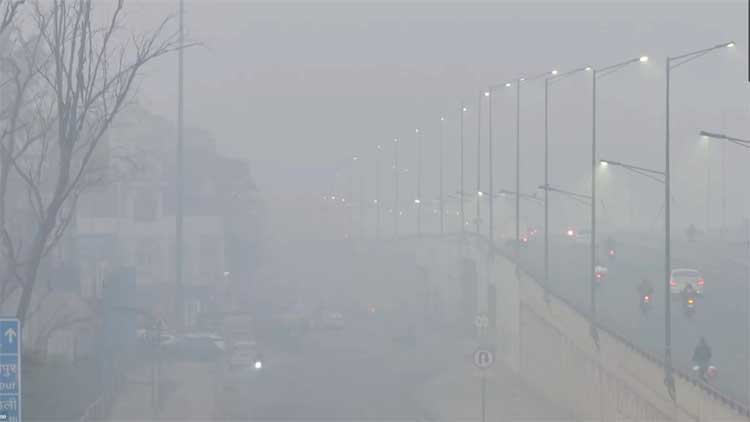
A thick layer of smog blanketed Delhi on Saturday morning as air quality remained dangerously high, with the air quality index (AQI) recorded at 390 at 7 am—firmly in the ‘very poor’ category and edging close to the ‘severe’ mark.
According to the Central Pollution Control Board (CPCB), the 24-hour average AQI stood at 349 at 4 pm on Friday, also falling in the ‘very poor’ category. However, pollution levels worsened overnight, breaching the ‘severe’ threshold in several parts of the national capital.
By 8 am on Saturday, major areas of Delhi reported AQI readings above 400. Wazirpur recorded an AQI of 445, Jahangirpuri and Vivek Vihar both stood at 442, while Rohini logged 436, CPCB data showed.
Other locations including Bawana (428), Anand Vihar (436), Mundka (426), Chandni Chowk (419), Narela (431) and ITO (425) also reported ‘severe’ air quality levels.
Experts said pollution levels are expected to dip slightly in the coming days but are likely to remain in the ‘very poor to severe’ range, PTI reported.
Air quality across the National Capital Region (NCR) also remained alarming. Noida recorded a ‘severe’ AQI of 448, while Meerut stood at 368, Faridabad’s Sector 11 at 351, and Gurugram at 317—ranging from ‘very poor’ to ‘severe’.
The Decision Support System (DSS) for Delhi’s Air Quality Management identified transport as the single biggest contributor to pollution on Friday, accounting for 16.5 per cent of emissions. Construction activity contributed 2.2 per cent, followed by waste burning at 1.4 per cent.
Earlier on Friday morning, Delhi’s AQI was recorded at 332, with at least 30 monitoring stations reporting ‘very poor’ air quality.
Meanwhile, the Commission for Air Quality Management (CAQM) in NCR and adjoining areas announced the formation of an expert panel to devise strategies to combat air pollution, particularly from vehicular emissions.
The panel will be headed by Ashok Jhunjhunwala, Professor at IIT Madras, and will include health experts and academicians. CAQM said the group is being constituted in view of the “urgent necessity” to address air pollution caused by vehicles in the Delhi-NCR region.
The panel is expected to consult stakeholders and submit its recommendations within two months.
Comments are closed.