
Taiwan Recall Vote Fails to Unseat Opposition Lawmakers, Ruling Party Faces Setback

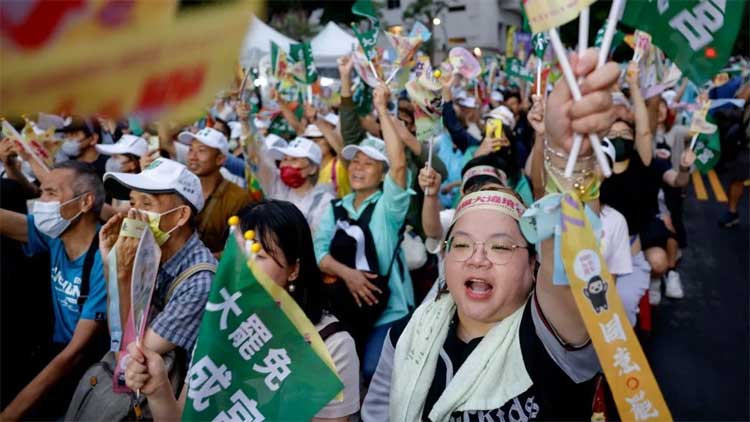
Taiwanese voters on Saturday rejected a mass recall effort aimed at removing around one-fifth of opposition lawmakers from the China-friendly Kuomintang (KMT) party, delivering a blow to the ruling Democratic Progressive Party (DPP)’s hopes of shifting the balance of power in the legislature.
Despite winning the presidency earlier this year, the independence-leaning DPP lacks a legislative majority. The KMT, along with the smaller Taiwan People’s Party (TPP), currently holds a majority bloc in the legislature, making it difficult for President Lai Ching-te to advance his agenda.
Preliminary results from Saturday’s vote showed that none of the two dozen KMT lawmakers targeted in the unprecedented recall attempt were removed. Seven more face a similar vote on August 23. For the DPP to gain control of the legislature, at least six KMT lawmakers would need to be successfully recalled, followed by DPP victories in the subsequent by-elections within three months.
Under Taiwan’s rules, a recall vote must gain support from more than a quarter of eligible voters in the lawmaker’s district and must surpass the number of votes against it to pass.
If the next round of recall efforts also fails, President Lai’s administration is expected to continue facing significant legislative resistance ahead of the 2028 elections.
Political Reactions
President Lai responded to the outcome by emphasizing that both the recall campaigns and opposition to them were legitimate expressions under Taiwan’s democratic system. In a Facebook post, he thanked civic groups for their efforts, saying they helped reinforce Taiwan’s commitment to resisting authoritarianism and defending its sovereignty.
“This result is neither a victory for one side nor a defeat for the other,” Lai said, calling for all political parties to work together to protect Taiwan’s democracy.
KMT chairman Eric Chu welcomed the outcome, framing it as a public endorsement of political stability. “Taiwanese people have chosen a government that should focus on results, not political infighting,” he said, demanding an apology from Lai for initiating what he described as a divisive campaign.
Lev Nachman, a political science professor at National Taiwan University, noted the DPP faced an “uphill battle” in trying to recall lawmakers from deeply entrenched KMT districts. He said the result would further hinder Lai’s ability to govern effectively in the near term. “Lai will now need to find new, creative ways to connect with the public,” Nachman said.
Fu Kun-chi, a prominent KMT lawmaker and recall target, called on President Lai to engage with the opposition and work toward national stability in a “chaotic world.”
DPP Secretary-General Lin Yu-chang acknowledged the setback and pledged that the party would reflect on public sentiment and adjust its approach accordingly.
Accusations of Political Retaliation
The DPP and its supporters have accused the KMT of obstructing key legislation, including defense funding, and pushing through changes that weaken executive authority and favor Beijing. They argue the recall efforts were necessary to protect Taiwan’s democracy and security.
However, the KMT described the recalls as politically motivated retaliation, accusing the ruling party of undermining democratic principles after losing legislative control.
The vote has heightened tensions between those supporting the status quo and others advocating closer ties with China. Critics of the KMT say its outreach to mainland Chinese politicians jeopardizes Taiwan’s autonomy, while the KMT defends these ties as essential for maintaining dialogue with Beijing.
China also weighed in. Chen Binhua, a spokesperson for China’s Taiwan Affairs Office, claimed the vote results exposed the DPP’s alleged attempt to dominate politically, calling it “fake democracy, real authoritarianism.” Taiwan’s Mainland Affairs Council pushed back, accusing Beijing and Chinese state media of trying to interfere in the election.
With the recall campaign now partially stalled, attention shifts to the upcoming August vote, which could further shape Taiwan’s legislative dynamics and determine how much room President Lai’s government has to maneuver.
Comments are closed.