
Taiwan and China Clash Over WWII Legacy as 80th Anniversary Marked

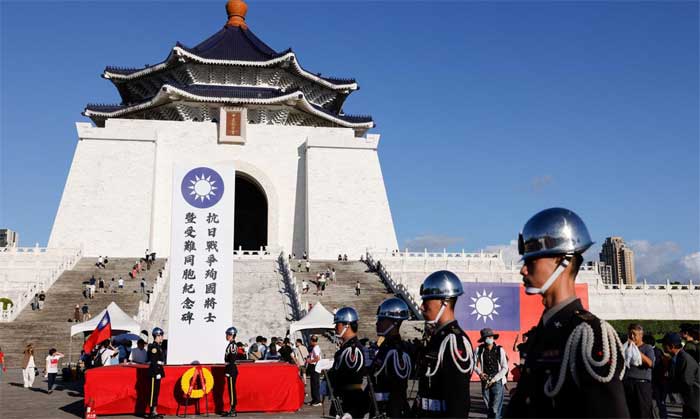
Veteran Pan Cheng-fa, 99, vividly recalls fighting Japan during World War II under China’s republican government. But he grows agitated when asked about the communists, who at the time were uneasy allies.
“We gave them weapons, equipment — we strengthened them,” Pan said at a commemoration in Taipei. “After Japan was defeated, their next target was the Republic of China.”
As Beijing prepares a grand military parade to mark Japan’s surrender, Taipei is holding low-key ceremonies while the two sides trade accusations over who deserves credit for victory.
Fighting in China began in 1937 with Japan’s full-scale invasion and ended in 1945, when Taiwan — then a Japanese colony — was handed to the Republic of China. Four years later, the civil war forced Chiang Kai-shek’s government to retreat to Taiwan, where it still exists.
The Chinese Communist Party (CCP) frequently portrays itself as the backbone of resistance against Japan. But Taiwan’s officials stress that the People’s Republic of China (PRC) did not yet exist, and that Chiang’s forces bore the brunt of the fighting.
“History affirms that the War of Resistance was led and won by the Republic of China,” Taiwan’s defense ministry declared at a concert that honored republican troops and U.S. volunteer pilots known as the Flying Tigers.
Chiu Chui-cheng, Taiwan’s top China-policy maker, accused Beijing of “repeatedly distorting the facts.” The Mainland Affairs Council echoed wartime claims that Mao’s strategy prioritized strengthening communist forces over fighting Japan.
Beijing has dismissed such statements. In a commentary, the CCP’s People’s Daily warned against “distorting and falsifying” its role, insisting victory belonged to all Chinese, including those in Taiwan. It also frames the war’s end as Taiwan’s “return” to China in 1945.
Taipei counters that no treaty transferred Taiwan to the PRC, which was only founded in 1949. President Lai Ching-te used the August 15 surrender anniversary to caution that “aggression will be defeated” — a veiled rebuke of Beijing’s military threats.
Pan, who says relatives left behind in mainland China were brutalized after the communist takeover, sees little reason to celebrate Beijing’s parade.
“I can’t say anything good about the communists,” he said.
Comments are closed.