
Summer heat to return; rain unlikely for a week in Delhi, northwest India: IMD

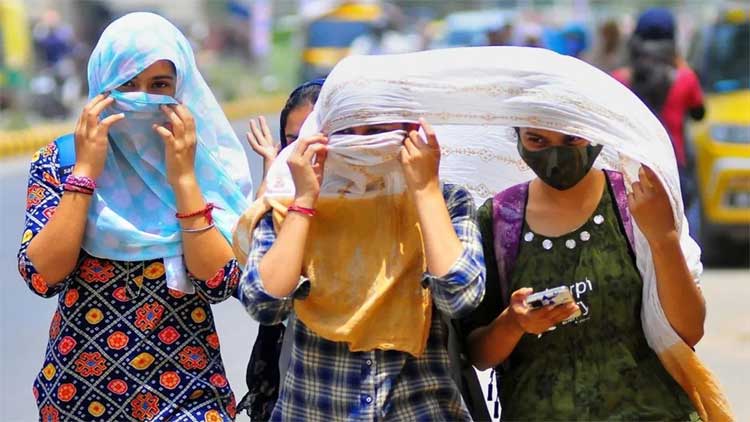
Delhi and parts of northwest India are in for a hot week ahead even as monsoon rains are expected to remain stalled over central India for the period, according to the India Meteorological Department.
IMD forecasts show that rainfall activity in the region will only start picking up after a week, bringing relief from an intense spell of heat.
The heat began to settle in on Saturday itself in the national capital with the mercury inching close to 40 degrees Celsius (°C) — base weather station Safdarjung recorded a maximum of 39.8°C, around normal for this time of the season.
The maximum is expected to further rise, by 3-4°C, in the next five days, the weather department has forecast.
In Delhi, it is likely to touch 42°C on Sunday and possibly go up to 44°C by Tuesday – making it the hottest week so far this season. The highest maximum recorded in the Capital so far is 42.3°C on May 16.
This will also likely be one of the last intense heat spells, before the monsoon resumes progress in other parts of India.
Monsoon has not progressed for over a week now — its progress had stalled around May 29 because of intrusion of dry air. It will again commence advancement during the week of June 12 to 18, according to IMD’s extended range forecast.
Till now, most parts of the country saw an unusually cooler summer as the southwest monsoon arrived earlier than usual.
Normally, the monsoon covers a majority of the country by June-end and the entire country by July 8. It typically reaches Delhi on June 27.
“Models suggest that at least June 12, monsoon will be very weak. This is due to weaker monsoon flow and dry air intrusion from northwest. The longer hiatus has become now seen during the monsoon progress. There is a systematic in increase of hiatus days,” said M Rajeevan, former secretary, Union ministry of earth sciences.
“However, it may revive during the third week of June,” he added.
Temperature crosses 40°C in parts of Delhi
In Delhi, Ayanagar station recorded the highest maximum temperature (41.2°C) on Saturday, followed by Palam (40.7°C).
Meanwhile, the air quality deteriorated to the “poor” category with an AQI of 209, prompting the Commission for Air Quality Management in NCR to invoke preventative air pollution control measures under Stage 1 of the Graded Response Action Plan (Grap) with immediate effect.
Though no heatwave or colour-coded alert has been issued for the city yet, IMD said heatwave conditions are likely in parts of Punjab, Haryana, Chandigarh, Uttar Pradesh, Madhya Pradesh and west Rajasthan.
IMD scientist Naresh Kumar said while temperatures were currently below normal in several parts of the country, this will gradually change over the next four to five days.
“There is a possibility of heatwave conditions returning in parts of northwest India, specifically west Rajasthan from around June 9. In parts of Punjab, Haryana, UP and MP, heatwave is likely on June 10,” Kumar said. “It may possibly touch 43 to 44°C in Delhi-NCR too.”
IMD classifies it as a heatwave, when the maximum is over 40°C, with the departure being 4.5°C or more above normal. It is also a heatwave if the maximum is over 45°C in the plains. It is a “severe heatwave” if the maximum is over 40°C and the departure is 6.5°C or more above normal.
Mahesh Palawat, vice president at Skymet meteorology said weather systems in the region, including a western disturbance and a cyclonic circulation, have both weakened. “Monsoon will start picking up from June 13. Until then almost to dry weather conditions over Punjab, Haryana, Delhi Uttar Pradesh, Madhya Pradesh, Rajasthan, Bihar, Jharkhand West Bengal, Odisha and Chhattisgarh including Western Himalayas,” he said.
Increase in rainfall activity from June 10
There is likely to be an increase in rainfall activity with isolated heavy rain very likely over south peninsular India and northeastern states from June 10.
IMD’s Kumar said: “After three to four days, the monsoon will revive across the entire southern peninsula with heavy rainfall returning in Kerala, Karnataka and Tamil Nadu.”
It has been an unusually cool summer so far, with excessive rains last month largely keeping the temperature in check. May ended with 184.6mm in monthly rainfall — the highest ever for Delhi, data from 1901 showed. May also did not see a single heatwave day this year, as compared to six such days last year.
The highest maximum last year at Safdarjung was 46.8°C on May 29. It even crossed 49°C in some parts during the six-day spell between May 26 and 31.
Comments are closed.