
Somalia’s Fragile Front Line Strains as Conflict Intensifies

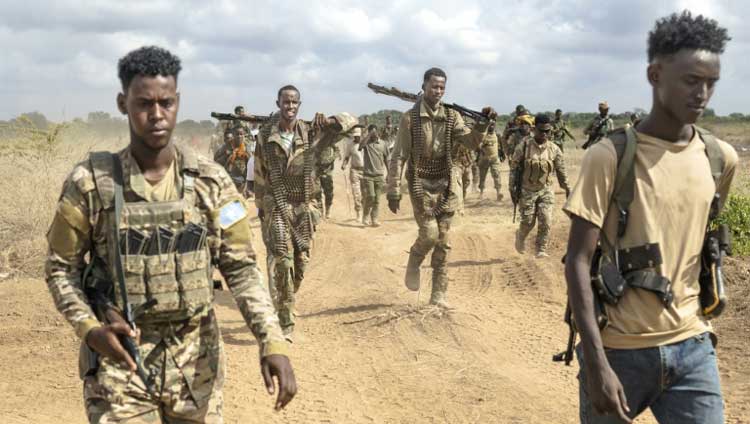
The helicopter pilot is anxious. Spend more than 20 minutes on the ground in this shattered frontline village, he warns, and Somalia’s Al-Shabab militants could begin firing mortars.
Roughly 1,000 Somali National Army (SNA) troops, backed by an African Union contingent, are clinging to control of Awdheegle, a strategic town about 60 kilometers from Mogadishu, retaken from the Al-Qaeda-linked insurgents less than seven weeks ago. Their grip is tenuous, and the aging helicopter ferrying reporters is a tempting target for militants positioned just a few miles away.
“Five more minutes, and I would have left you,” the pilot says as journalists scramble aboard and the aircraft lifts off, banking over the town’s ruins. Little remains intact in Awdheegle.
“I found my house demolished. I have nothing to rebuild it,” said 65-year-old resident Abdi Osman Hassan, who recently returned.
A similar picture emerges in Sabiid and Canole, two deserted settlements about 10 miles closer to Mogadishu. The areas are cratered landscapes after sustained drone and air strikes, which SNA commanders say were the only way to dislodge militants who had dug tunnels and planted explosives. The offensive succeeded in June, but retreating fighters blew up the bridge between the villages — using so much dynamite that virtually nothing was left.
A new bridge, built with Turkish assistance, has just been completed under the watchful supervision of a tight-lipped Ugandan unit. But even that accomplishment feels precarious. A Turkish contractor working on the front line told AFP he doubted it would last long.
“If the powers do not behave and talk to each other, then the bridge…” he said, snapping his fingers to mimic another explosion. “Right now, everyone is feeding the dogs of war.”
Al-Shabab Regains Territory
Somalia has been fighting Al-Shabab since the mid-2000s, and frontline towns like Awdheegle, Sabiid and Canole have changed hands many times. The SNA made significant gains in 2022 and 2023, retaking around 200 towns and villages. But early this year, the insurgency mounted a fierce counteroffensive, reclaiming about 90% of that territory — including three key bridges along the Shabelle River, crucial for reaching the capital.
Since 2007, Somalia has relied on African Union missions funded largely by Western donors. But support is shrinking. The most recent iteration of the AU mission, AUSSOM, launched in January with a $92 million budget shortfall, in addition to an existing $100 million debt. Analysts say the already overstretched SNA is now under immense strain.
Somalia’s national security adviser Awes Hagi Yusuf acknowledges the challenges but says new agreements with “non-traditional” partners such as Türkiye and the United Arab Emirates are helping bridge the gaps.
“The fight that we are doing, it’s not confined and limited to Somalia,” he said. “This is a global war.”
Bilateral Deals Offer Limited Relief
Somalia is expected to rely more on bilateral arrangements with individual nations, including neighbors like Kenya and Uganda. But security analyst Samira Gaid questions the sustainability of such models.
“Funding is always going to be an issue, even for these bilateral forces,” she said. “There’s a lot of kicking the ball to the next stage, hoping somebody else has to deal with it.”
Political distractions in Mogadishu ahead of next year’s elections further complicate efforts. “Whenever there is this political contention, everything else is neglected,” said Mahad Wasuge of the Somali Public Agenda think tank.
Communities Caught in the Middle
Yusuf says the government has regained control of “the whole area” within 300 kilometers of Mogadishu and plans to next retake bridges and villages in Upper and Middle Shabelle. He did not offer a timeline.
But during AFP’s visit, towns like Awdheegle and Bariire, well within the so-called liberated zone, did not feel secure. Soldiers hovered near residents as they spoke to reporters; in one instance in Bariire, troops motioned for a woman to deny fearing Al-Shabab’s return.
“We are peasants, our houses were destroyed, and we have no help so far,” said Muslimo Hassan Isaq, 56. She fled to Mogadishu’s outskirts, where she lives in a makeshift shelter after abandoning her farm eight months ago.
“I don’t know where to start,” she said. “We need to be looked at and cared for. I cannot rebuild myself.”
Caught between shifting frontlines, exhausted communities say legitimacy is in short supply. “All that matters,” said Gaid, “is who stays longer and who provides some modicum of security and justice when they’re in place.”
Comments are closed.